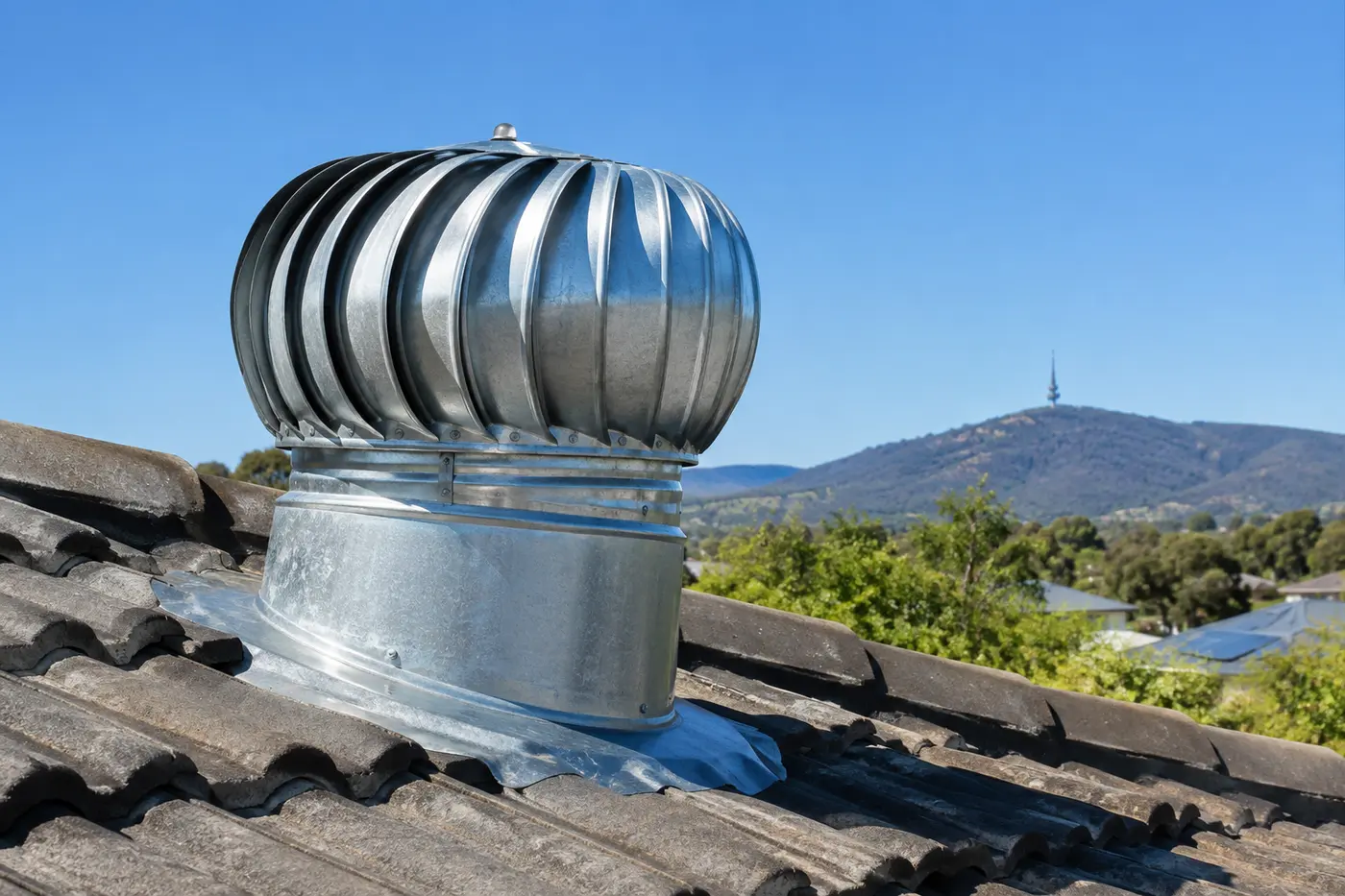
Here is the call we get most in February. The upstairs bedrooms are stifling by mid-afternoon, the aircon runs all evening and the room still feels like an oven at bedtime. Then in July the same house has the opposite problem: a musty smell in the hallway, a few dark spots creeping across a bedroom ceiling, maybe a bit of mould near the cornice. Two complaints, two seasons, one cause. The roof cavity has nowhere to breathe. That is where roof ventilation comes in, and in a Canberra climate it matters more than most people think.
Roof ventilation is simply a way of letting the hot, damp air trapped in your roof space escape, while drawing cooler, drier air in to replace it. Get that airflow right and the space above your ceiling stays closer to the outside temperature instead of turning into a sealed box that bakes all summer and sweats all winter.
What a roof cavity does when it can't breathe
Think of the space between your ceiling and the roof itself. In summer, sun hits the tiles or metal and that heat radiates down into the cavity. By late afternoon it can sit well above the outdoor temperature, and because heat rises, it presses down on your ceilings and leaks into the rooms below. Your cooling is fighting the roof, not just the weather.
Winter flips the problem. Warm, moist air from cooking, showers and drying clothes drifts up through the ceiling. When it meets the cold underside of a roof on a frosty Canberra night, it condenses into water, the same way a cold glass sweats on a warm day. That moisture settles on the timber, the insulation and the sarking (the foil-backed sheet under the roof covering). Over time it feeds mould, and it can rot the very timbers holding your roof up.
Why Canberra's climate makes this worse than the coast
Most Canberra homes were built to hold heat in, which is exactly what you want on a minus-five morning. The trouble is that a well-sealed home traps the bad air along with the good. Our summers are hot and dry, so the cavity heat-loads hard during the day and stays warm long after dark. Our winters are properly cold, with heavy frost and overnight lows below zero, which is prime condensation weather inside the roof.
That winter condensation is the one that surprises people. We have been called out to what the owner was certain was a leak, only to find the roof itself was sound and the water was coming from inside, forming on cold metal and dripping onto the insulation. If that sounds familiar, it is worth reading our guide on what a ceiling water stain is really telling you before you assume the worst about your tiles. The same cold-cavity problem also shows up in our notes on how Canberra frost works on a roof over a full winter.
The signs your roof space is struggling
You usually feel it before you see it. The things we hear about most often are:
- Upstairs or top-floor rooms that stay hot for hours after the rest of the house has cooled down.
- A musty or damp smell in the ceiling, wardrobes or hallway, worst in winter.
- Dark patches or spotty mould near ceilings, cornices and around downlights.
- Rust starting on the underside of a metal roof or on fixings, which points to moisture sitting in the cavity.
None of these prove you need ventilation on their own. A leak, blocked gutters or failing flashing can cause similar marks. That is why the honest first step is having someone get up there and look, rather than bolting a vent on and hoping.
Whirlybirds, static vents and powered fans: what the options are
There is no single best vent for every roof, and anyone who tells you otherwise is selling one product. The main choices break down like this.
Whirlybirds are the spinning turbines you see on rooftops. Wind and rising heat turn the vanes, which pull warm air out of the cavity. They cost little to run because they use no power, and on a breezy day they move a genuine amount of air. On a still, stinking-hot afternoon they slow right down, which is their honest limitation.
Static vents and tile vents have no moving parts. They sit quietly and let hot air rise out and escape. They are simple and reliable, and they suit tile roofs well, though each one moves less air than a turbine.
Powered and solar fans use a motor to actively push air out, so they keep working when the wind drops. A solar unit runs off a small panel, so it does the most work on exactly the hot, sunny days you need it and adds nothing to your power bill.
Do whirlybirds actually work?
Yes, within limits, and only if air can get in to replace what they pull out. This is the part most people miss. A vent up high is only half the system. You also need intake low down, usually through vents in the eaves or soffits, so there is a clear path for fresh air to enter, sweep across the cavity and leave. Fit outlets with no intake and the whirlybird just spins without shifting much air. A balanced setup beats a bigger vent every time.
How many vents, and can you overdo it?
You can technically fit too many, but in practice the far more common problem is too few, or outlets with no matching intake. The right number depends on your roof area, its pitch, the roof material and how the cavity is laid out. A small single-storey home is a very different job from a large two-storey with a complex roofline. Rather than guess, we work out the airflow the cavity needs and match the vents to it. That balance is the whole game.
People often ask whether the building rules require this. For a new build, the National Construction Code has tightened up on managing condensation in roofs over recent years. For an existing home, it is less about compliance and more about fixing a problem you can feel, and protecting the roof structure you already own.
Getting it done properly, and as part of the bigger picture
Cutting vents into a roof means opening the covering and making it watertight again, which is roofing work, not a weekend job. A vent fitted without proper flashing becomes the leak it was meant to prevent. Because of that, ventilation is often best sorted while other work is happening. When we carry out a full roof restoration, the roof is already being cleaned, resealed and gone over, so adding the right vents and checking the intake is straightforward and tidy. We are a licensed Canberra roof plumbing business (ACT Roof Plumber Licence 242220C), and our workmanship is backed by a 15-year warranty on selected services, conditions apply.
If your top floor cooks every summer or your ceilings smell damp every winter, do not just live with it or blame the aircon. Get the roof space looked at, find out whether poor airflow is the real cause, and fix it once. Call us on (02) 6109 5008 to arrange a look at your roof and a straight answer on whether ventilation is worth it for your home.