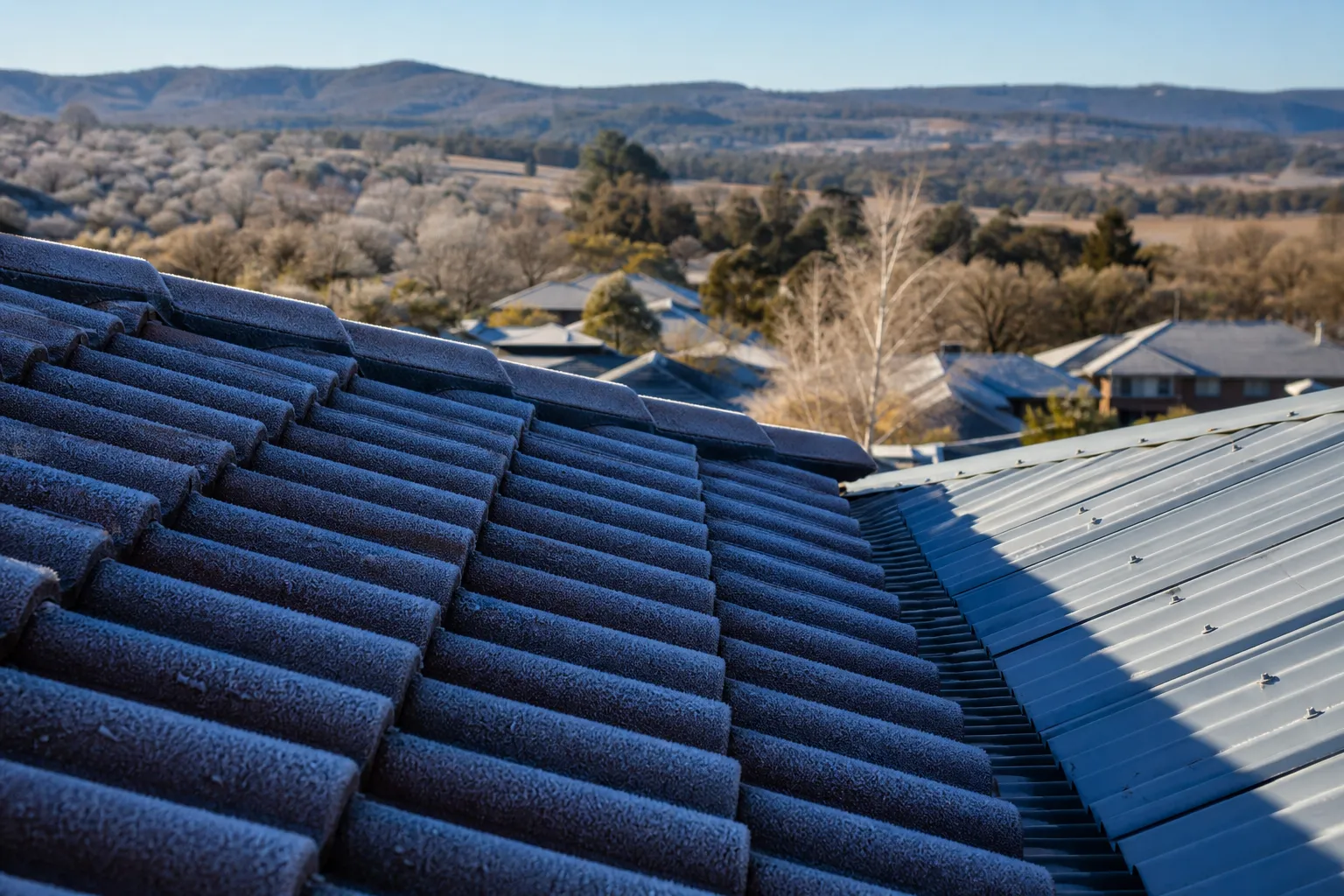
Canberra winters are hard on roofs in a way coastal cities never see. We routinely wake to heavy frost on the tiles and overnight lows well below zero, then watch the sun climb and the roof surface swing back above freezing within a few hours. That daily freeze-then-thaw cycle, repeated dozens of times between May and September, is one of the most destructive forces a Canberra roof faces, and most of the damage happens quietly, out of sight, until a leak appears in the ceiling.
This guide walks through exactly what the cold does to tile and metal roofs across the ACT, and the practical maintenance you can do before and during winter to stay ahead of it.
Why Canberra's cold is different
It comes down to moisture plus temperature swings. Our clear, dry winter nights let heat radiate away fast, so roof surfaces frequently drop below the surrounding air temperature and collect frost, even when the official overnight minimum reads a degree or two above zero. Any water sitting in a porous tile, a hairline crack, or a tired mortar joint freezes, expands by roughly nine percent, and then thaws. Do that over and over and small flaws become big ones.
Freeze-thaw cracking on tiles
Concrete and terracotta tiles are slightly porous, and older or unsealed tiles soak up more water than you'd think. When that trapped moisture freezes it pushes outward from inside the tile, causing spalling (the surface flaking away), fine cracks, and brittleness. Tiles that were perfectly sound in autumn can arrive at spring chipped, laminating, or cracked clean through. Walking on already-cold, brittle tiles to clear a gutter is a common way homeowners make it worse. Cold tiles crack under foot pressure far more easily than warm ones.
Ridge capping and mortar joint damage
The mortar bedding and pointing along your ridges and hips is the single most frost-vulnerable part of a tiled roof. Old-style cement mortar is porous, so it drinks up moisture and then cracks apart as that water freezes and expands. Once the pointing is cracked, more water gets in, the next frost widens the gap, and eventually ridge caps loosen or lift. Flexible pointing compounds applied over fresh bedding handle Canberra's freeze-thaw cycling far better than the traditional sand-and-cement mix. If your ridge lines look crumbly or you can see gaps, that's a repointing job that shouldn't wait. It's a core part of a roof restoration.
Condensation and moisture under metal roofing
Metal doesn't absorb water, so people assume Colorbond roofs are immune to winter trouble. They're not. On frosty nights the underside of a metal sheet gets very cold, and warm, moist air rising from inside the home condenses against it, the same way dew forms on a car bonnet. Without proper sarking (a reflective anti-condensation underlay) and ventilation, that moisture drips onto insulation and ceilings, mimicking a leak. Over time it also feeds rust from the inside out and rots timber battens. Adequate sarking and ventilation is the fix, and it's far easier to install during a re-roof than to retrofit later.
Expansion and contraction stress on metal roofs
Metal roofing expands as it warms in the day and contracts as it plunges below zero at night. Across a big temperature swing a long run of sheeting moves measurably, and that constant working stresses screws and fasteners. Over several winters you get backed-out screws, worn neoprene washers, enlarged fastener holes, and popped or oil-canning sheets, all of which let water track in. Loose or perished fasteners are one of the most common faults our team finds during metal roof leak detection, and they're cheap to fix before they leak but expensive once water has reached the ceiling.
Gutter and downpipe ice blockages
On the coldest Canberra mornings, water in gutters and downpipes can freeze, especially in shaded, south-facing sections that never catch the sun. Frozen leaf litter and debris block the flow, so when the frost melts or morning rain arrives, water backs up under the tiles and over the fascia instead of draining away. Blocked, sagging gutters full of wet debris are also heavier and pull away from the house. Keeping gutters clear going into winter is the simplest, highest-value job on this list.
What homeowners can do before and during winter
You can prevent the large majority of frost damage with a handful of sensible steps:
- Book an autumn inspection. The best time to find cracked tiles, tired pointing and loose fasteners is before the frosts arrive, not after a leak. A professional roof inspection with a photo report tells you exactly what needs attention.
- Clear gutters and downpipes. Remove leaves and debris in late autumn so meltwater and rain drain freely. Consider gutter guard if you're under Canberra's many deciduous street trees.
- Repoint and re-bed ridge capping. Have crumbling mortar replaced with a flexible pointing system that tolerates freeze-thaw movement.
- Check insulation and ventilation. Good ceiling insulation keeps warm, moist air out of the roof cavity, and roof or eave venting lets any condensation escape. Both cut the winter moisture problem at its source.
- Replace cracked tiles promptly. A single cracked tile lets water into the batten and cavity, where the next frost does far more damage.
- Stay off the roof. Cold tiles are brittle and frost makes every surface slippery. Leave winter roof work to a licensed roofer.
Frequently asked questions
Why is my roof leaking after a frost?
Two usual causes. On tile roofs, freeze-thaw has opened cracks or lifted pointing, so meltwater gets in as the frost thaws. On metal roofs, it's often condensation forming on the cold underside of the sheets rather than a true leak. A proper inspection tells the two apart, and the fix is very different.
Do roof tiles really become brittle in the cold?
Yes. Repeated wet-and-freeze cycles make porous tiles more absorbent and fragile over time, which is why older Canberra tile roofs shed and crack more each winter. Cleaning, repairs and a sealing coat as part of a restoration slow this down considerably.
Is winter a bad time to restore a roof in Canberra?
Winter is actually when problems reveal themselves, so it's a sensible time to assess and plan work. We schedule around the weather: coating and painting need dry, mild conditions, but repairs, repointing and leak fixes can proceed through most of the season.
Get ahead of the frost
Whether you have a tired tile roof shedding grit each winter or a metal roof sweating condensation onto the ceiling, the cheapest fix is always the one done before the leak. Our licensed local team knows exactly how Canberra's frosts behave, from Tuggeranong's frost-hollow valleys to the exposed ridges of Gungahlin. If you've spotted cracked tiles, crumbling pointing or a winter drip, book a free inspection and quote for roof repairs or a full restoration, and head into next winter with a roof built Canberra-tough.