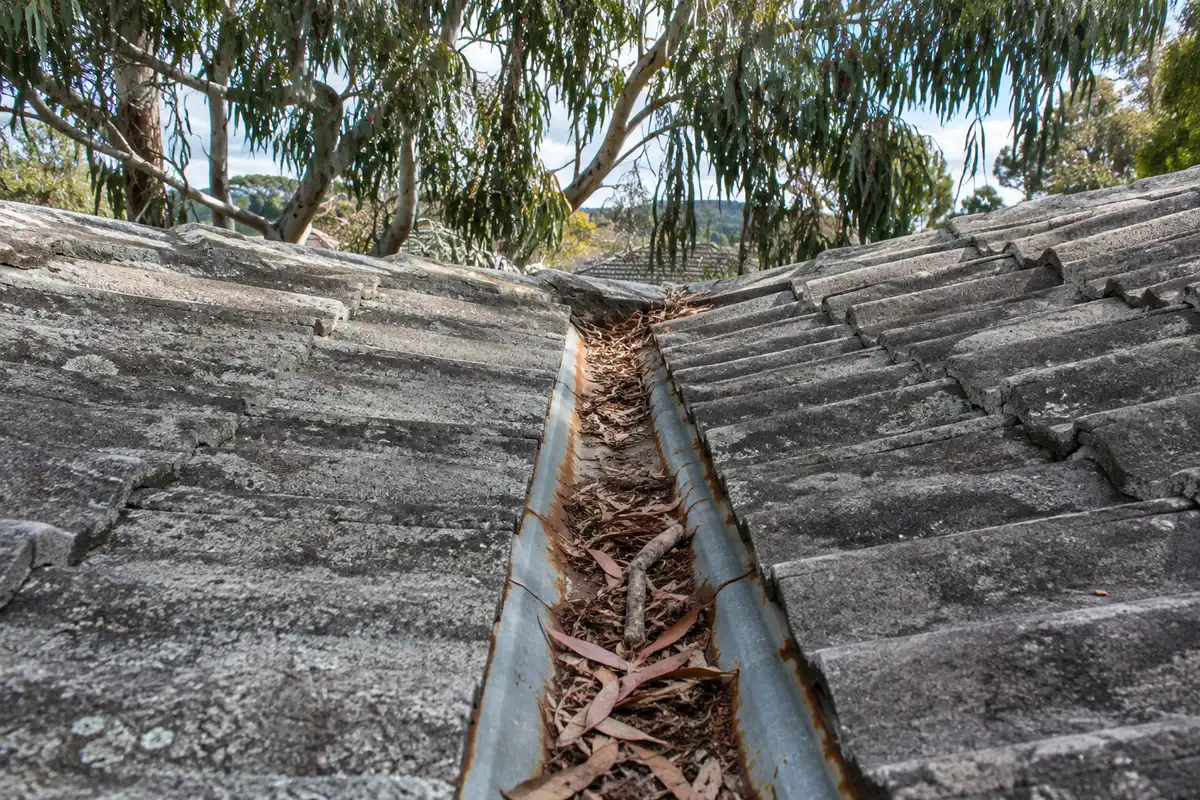
The stain is in the corner of the family room, right below where the roof of the extension joins the main house. It shows up after a big storm, dries out, then comes back a little wider the next time. Somebody went up once and said the tiles looked fine. They probably did.
When the leak sits under the spot where two roof slopes meet, we look at the valley first. Roof valley repair is one of the most common leak jobs we do around Canberra, and it is also one of the most often botched, usually with a tube of sealant. Here is what a valley is, why they fail on Canberra homes, and what a repair that lasts actually involves.
A valley carries more water than any other part of the roof
A valley is the internal fold where two roof slopes run into each other, like the crease of an open book. Rain from both slopes drains toward it, so in a heavy downpour a valley can be carrying the runoff from a big slice of the roof in one narrow channel.
On a tile roof, that channel is a strip of folded metal called a valley iron. It sits on timber boards under the tiles, and the tiles on each side are cut at an angle so they hang over its edges. On a Colorbond or other metal roof, the valley is a wider metal gutter that the sheets lap into. Either way, the valley is doing the hardest drainage job on the roof, which is why it is so often the first thing to give up.
Why Canberra valleys rust through and overflow
Leaf litter that never dries out
This is the big one. Canberra's leafy streets look lovely, but gum leaves, bark and seed pods collect in valleys and pack down into a wet mat. That mat holds moisture against the steel for weeks at a time. On older homes with galvanised valley irons, the zinc coating wears away under it and the steel rusts from the top down. We often lift the leaves out and find a valley that looks fine at the edges and is paper thin or holed through the middle.
A valley that can't carry a downpour
Some valleys were simply too narrow from the start, or the tiles were cut so far into the channel that they choke it. In a summer storm the water backs up, spills over the side of the valley iron and runs under the tiles. That kind of leak only appears in heavy rain, which makes it frustrating to pin down.
Frost working on the mortar
On many older tile roofs, the cut tiles along a valley were bedded in mortar. Our frosty winter mornings get into the hairline cracks, freeze, expand and break that mortar up. Tiles shift, gaps open and wind blows rain sideways into them.
Hail and foot traffic
A valley iron is thin metal sitting in the most exposed fold of the roof. Hail dents it and can split it at the folds, and anyone who has walked up a valley to reach a TV aerial may have flattened it. If you have had a hailstorm through your suburb, our guide to spotting hail damage on a Canberra roof covers what else to look for.
Signs the leak is coming from a valley
Please don't climb up to look. Valleys sit where the pitch changes, the tiles beside them are cut and loose, and wet leaf litter is slippery. Most of the clues are visible from the ground or from inside:
- a ceiling stain under the line where two roof sections meet, often near an extension or an L shaped corner
- a leak that only appears in heavy or wind driven rain
- water spilling over the side of the valley rather than running down it during a storm
- rust streaks on the tiles below the valley or at the gutter where it drains
- leaves, moss or small plants visibly growing in the valley
Water can travel along a batten or the sarking before it drips, so a stain near a valley isn't proof on its own. If the source isn't obvious, our article on how roofers trace a hard to find leak explains how we narrow it down.
Patching a valley rarely holds
The fix we are most often asked to redo is a valley that has had silicone, a bitumen patch or a strip of tape run over a rust hole. It might get you through one wet season. The trouble is that a valley is one continuous channel carrying a lot of water. Once one spot has rusted through, the rest of the iron has usually been sitting under the same wet leaves for the same number of years, and the next hole is rarely far away.
A patch also adds a lump in the channel that catches more debris, and it cannot help a valley that was too narrow to begin with. So for a rusted valley iron, the honest answer is almost always to replace the full length rather than chase holes in it.
There are exceptions. If the iron is sound and the leak is from cracked mortar or a few slipped tiles along the edge, rebedding and repointing those tiles is the right repair, and the valley itself can stay.
What replacing a valley involves
On a tile roof, the cut tiles along both sides are lifted and set aside. The old valley iron comes out, and we check the valley boards underneath, because a valley that has leaked for a while can leave the timber soft. A new valley in Colorbond or Zincalume steel goes in, sized to carry the water properly, and the tiles are relaid over it. Where the tiles were bedded in mortar, they are rebedded and pointed so they sit firm against our frosts.
On a metal roof the principle is the same. The sheets are lifted back where they lap into the valley, a new valley gutter is fitted, and the sheets are refixed with fresh screws and sealed laps.
Materials matter here. Copper and lead don't mix with modern coated steel. If water runs off an old copper or lead flashing into a new Zincalume valley, it corrodes the steel early. Part of doing the job properly is checking what drains into the valley before choosing what goes in it.
Valley work is licensed roof plumbing in the ACT
In the ACT, valleys fall under roof plumbing, which is a licensed trade. Get the width, fall or overlap wrong and the roof leaks no matter how good the tiles are. As licensed roof plumbers (ACT Roof Plumber Licence 242220C), we handle valley iron replacement and the rest of the roof plumbing on Canberra homes every week, from single rusted valleys on extensions to a full set on an older hip roof.
If you are planning a restoration, the valleys should be checked and replaced where needed before any coating goes on. A fresh coat of paint over a rusted valley only hides the problem until the next storm.
What it costs depends on the valley and the roof
We don't quote valley work over the phone, because the price depends on what we find. A single short valley on a single storey roof is a very different job from several long valleys on a steep two storey home, and soft valley boards add to it. Roof plumbing is quoted by the job: a single valley is a modest fixed price, a full set is larger, and you get a written quote once we know exactly what is leaking and why.
Get the valley looked at before winter
A valley leak caught early is usually one tidy job. Left through a wet Canberra winter, it can soak the valley boards, the sarking and the ceiling below. Our roof inspections are free and come with a photo report, so you can see the rust or the overflow point for yourself. Selected services carry a 15-year warranty (conditions apply). To book, visit our roof plumbing page or call (02) 6109 5008.