It has leaked three times this year, always in the same corner of the lounge room. Two people have already been up on the roof. One swapped a cracked tile. The other ran a bead of silicone around the flue. The bucket is still out every time it rains.
When we get that call, the repairs usually weren't the problem. The problem was that nobody found the leak before they started fixing things. Good roof leak detection in Canberra is mostly patient elimination: work out where water could be getting in, then rule places out one at a time until only one answer is left. Here's how that works, and what you can do to make it faster.
The drip is rarely under the hole, which is why leaks get missed
Water that gets past a tile or a sheet of steel doesn't fall straight down. It runs along a batten, slides across the top of the sarking (the foil layer under the tiles) or tracks along a rafter, and only drops into the ceiling when it reaches a low point. The wet patch can end up a couple of metres from the real entry point. If you're still working out how serious the mark itself is, our guide to reading a water stain on your ceiling covers that side.
For detection, the point is simple. Whoever fixes your leak has to follow the water back uphill to where it started. Patching whatever looks worst directly above the stain is a guess, and a guess is how you end up with two repairs and the same bucket.
When it leaks tells us as much as where
This is the part most people skip, and it's the most useful thing you can give a roofer. The pattern of a leak narrows the search before anyone climbs a ladder. These are the patterns we see most:
- Only in long, heavy downpours. Often a valley, box gutter or gutter that can't carry the volume and backs water up under the roof.
- Only in storms with strong wind. Rain pushed sideways under ridge caps, past flashings or through the laps between metal sheets.
- A day or two after the rain stops. Water soaked into insulation or pooled on the sarking, slowly finding its way down.
- On cold, clear mornings with no rain at all. Possibly not a leak. Canberra frosts can cause condensation on the underside of a metal roof, and it drips like one.
- On a dry, warm day. Look past the roof: a pipe in the ceiling, a hot water unit, or a roof mounted cooler or air conditioner.
So before anyone comes out, jot down the date, what the weather was doing and how long after the rain started the drip appeared. Take a photo of the stain each time it gets wet. Please stay off the roof yourself. Tiles crack underfoot, metal is slippery when damp, and a fall is a much bigger problem than a leak.
Four ways a leak gets traced, from quickest to slowest
Most leaks are found with the first two steps. The stubborn ones need all four.
1. Following the trail inside the roof
If the ceiling has a manhole and there's safe room to move, the roof cavity is often the best place to start. Water leaves tracks: dark marks on timber, tea coloured stains on the sarking, a patch of insulation that's flattened or damp. Following those marks uphill can lead almost straight to the problem.
2. A close look from the roof
Up top, a roofer checks everything above and uphill of the trail. On a tile roof that means cracked or slipped tiles, gaps in the ridge pointing and rusted or leaf filled valleys. On metal it means lifted flashings, unsealed penetrations and the rubber washers under the roofing screws. Plenty of leaks are obvious once you're standing next to them.
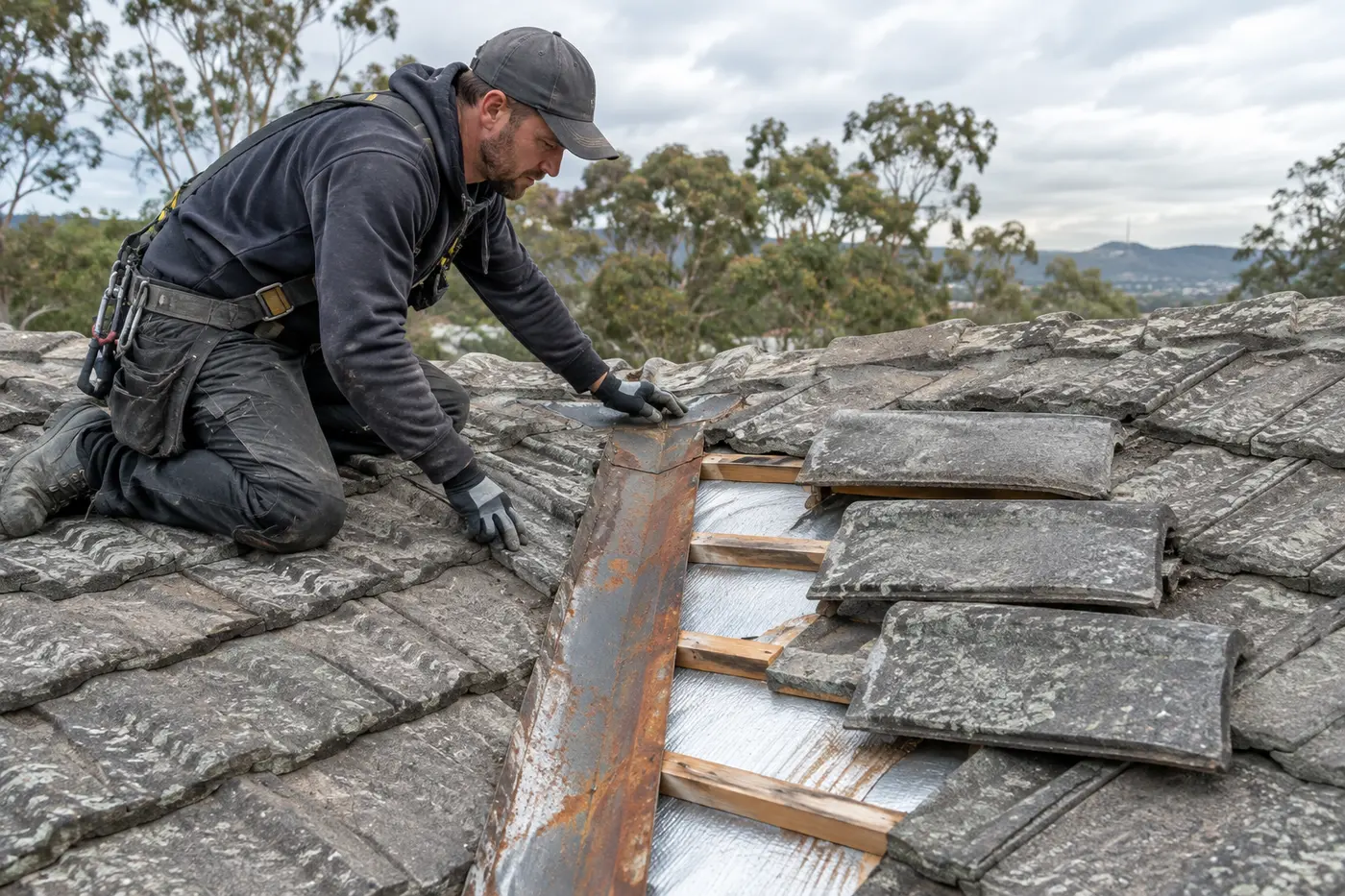
3. Lifting tiles to see underneath
Some damage only shows from below. Lifting a few tiles near a suspect area lets you see the underside, the battens and the sarking, and whether the timber is stained or soft. It's slower, and on an old, brittle roof it has to be done carefully.
4. A water test, one section at a time
When the leak is intermittent and nothing is obviously wrong, a hose test settles it. One person runs water over a single small section of roof, starting low and working upward, while another watches inside for the first drip. Each section needs time before you move on, so this can take a while. It also only works in dry weather.
You'll see some firms advertise thermal imaging cameras and moisture meters. They're useful for showing where the ceiling or insulation is wet. Just keep in mind they show where the water ended up, which isn't always where it got in.
Tile and metal roofs hide leaks in different places
On the older tile roofs common through much of Canberra, our frost does a lot of the damage. Water gets into hairline cracks and old ridge pointing, freezes overnight and opens them a little wider each winter. Valleys under big trees collect leaf litter that holds water against the steel until it rusts through.
Metal roofs fail at the details instead. The rubber washers under the screws perish, typically around the 15 to 25 year mark, and water weeps in around them. That's why the earliest estates in Gungahlin, which now carry 20 to 25 year old roofs, are where we do a lot of Colorbond leak detection and re-screwing. On near new homes in the Molonglo Valley it's more often a flashing or penetration that was never sealed properly when the house went up. Solar panels add another layer, because they cover part of the roof and bring their own fixings.
Sealant on a guess makes the next search harder
A tube of silicone is cheap and it feels like progress. The trouble is that a guessed patch can shift where the water travels without stopping it, so the leak moves a metre along and the trail you were following is gone. The next roofer then has to strip off old sealant before they can even see what's underneath.
We'd much rather find the cause once. That's the whole idea behind tracing and fixing roof leaks properly: identify the actual entry point, show you photos of it, then replace the failed part rather than smearing over it. As licensed roof plumbers (ACT Roof Plumber Licence 242220C), the valleys, flashings and fixings where most leaks start are the detail we work on every week.
Some leaks take two visits, and that's honest
Most leaks are found and fixed in one go. A few, usually the ones that only show up in a particular kind of storm, can't be proven until the next heavy rain. In those cases the right approach is to fix the most likely cause, then check the ceiling after the next real downpour. If water is coming in right now and more rain is forecast, urgent leaks are prioritised: we get you watertight first and come back to sort the detail once the weather allows.
Be wary of anyone who promises a certain answer from the ground or over the phone. A leak that has beaten two repairs already won't give itself up from the driveway.
Get the leak found before the next rain
Our roof inspections are free and come with a photo report, so you can see the cracked pointing or the perished screw for yourself. Small repairs are quoted on the spot once the cause is found, and selected work is backed by a warranty of up to 15 years (conditions apply). If you've got a leak that keeps coming back, book a leak inspection or call (02) 6109 5008, and bring your notes on when it drips.