It usually starts with a restoration quote that didn't go the way you hoped. Someone gets up on the roof, taps a few tiles, and comes down to tell you the tiles are too far gone to be worth coating. Now you're pricing a whole new roof, and the numbers you're seeing online are all over the place.
Roof replacement cost in Canberra swings a long way from one house to the next, and there are good reasons for that. This post won't pretend to price your roof from a screen. What it will do is walk you through what actually sets the number, where the money goes, and how to read a re-roof quote so you know what you're comparing.
A new roof is priced as a different job, not a bigger restoration
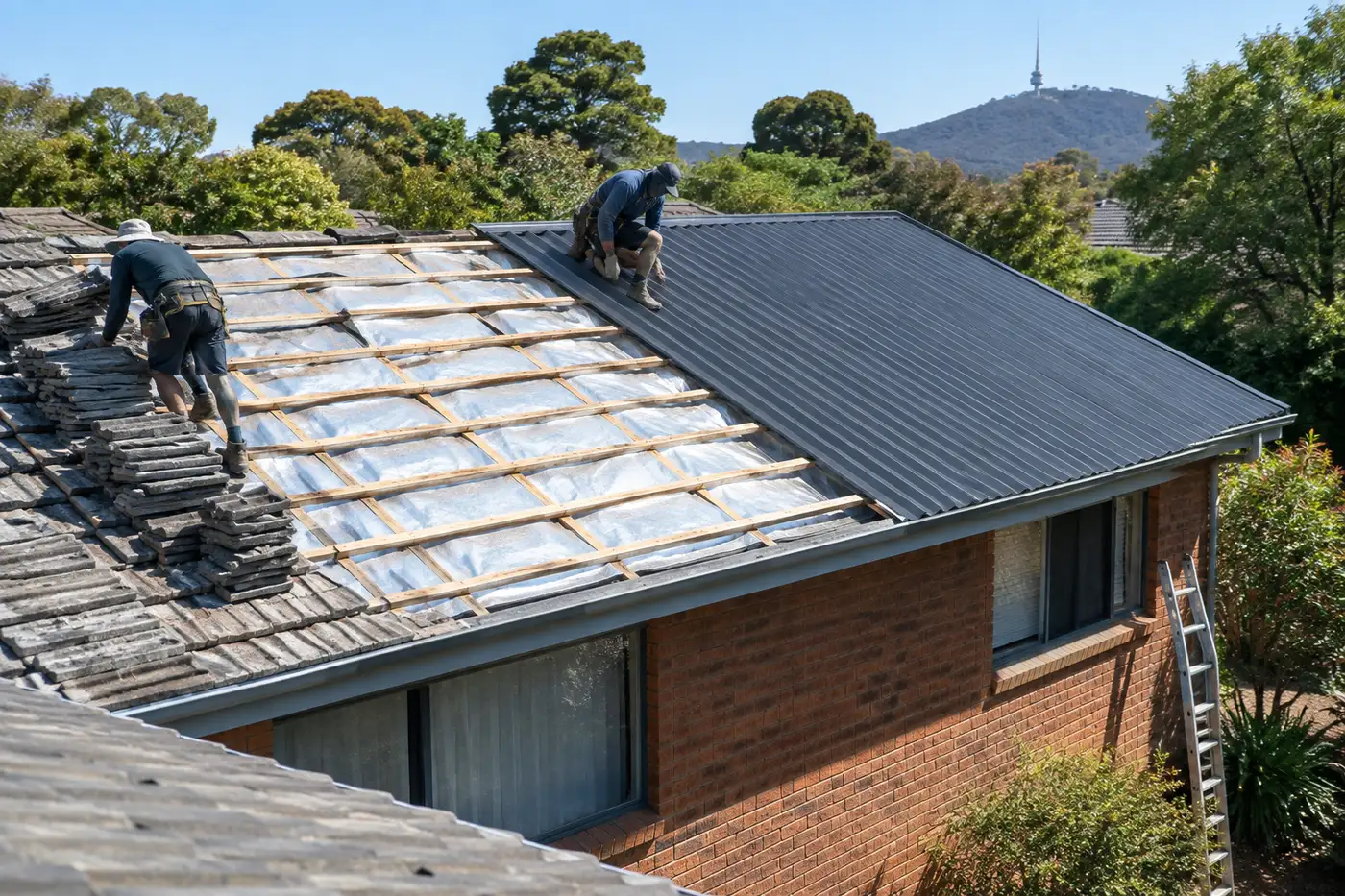
People sometimes expect a replacement to cost "a restoration, plus a bit." It doesn't work like that. A restoration keeps your existing tiles and renews the weatherproofing on top. A replacement takes the whole roof covering off, deals with whatever is underneath, and builds a new roof from the battens up.
That means more labour, more material, a skip or truck for the old roof, and usually new gutters, valleys and flashings as part of the package. If you're still weighing up whether your roof could be restored instead, our guide to what a restoration costs in Canberra covers that side of the decision.
Five things that set the price of a new roof
When two re-roof quotes land thousands apart, it's rarely random. Almost every difference traces back to one of these.
1. Roof size, pitch and storeys
Size is the obvious one. More square metres means more sheeting or tiles, more battens, more sarking and more hours. Pitch matters nearly as much. A steep roof needs more safety gear, more careful handling and slower work. A two-storey home adds scaffolding and edge protection, and a roof with lots of hips, valleys and dormers takes far longer to cut and flash than a simple gable.
2. The material you're going to
Re-roofing in concrete or terracotta tile and converting to Colorbond steel are priced differently. Swapping old tile for Colorbond is the re-roof Canberra homeowners ask us for most. The steel itself isn't the only cost. Changing material can mean different batten spacing, new flashings to suit, and sometimes adjustments where the roof meets walls and chimneys. We've gone through the trade-offs in detail in our Colorbond versus tile comparison, so here we'll stick to cost.
3. What's hiding under the old roof
This is the one nobody can fully see until the tiles come off. Once the roof is stripped, the battens and roof timbers are exposed and checked. On a lot of older Canberra homes they're fine. On others, years of slow leaks have left soft or split battens that need replacing before anything new goes on top.
Our quotes are fixed prices, given after we've inspected the roof structure. Whoever you get quotes from, ask how they've allowed for timber repairs, because a low price that leaves this out is really just a smaller job with the same name.
4. The extras that ride along
An open roof is the cheapest moment you'll ever get to fix the layers underneath it. Most re-roofs include fresh sarking, the reflective foil layer that sits under the roof covering as a second barrier against water and heat. Many homeowners also take the chance to add or upgrade roof insulation while everything is exposed, which makes a real difference through a Canberra winter. New gutters, downpipes, valleys, flashings and ridge capping usually go on at the same time so the whole system matches and ages together.
Each of these adds to the quote. Each is also far dearer to do later as a separate job, once the new roof is sitting on top of it.
5. Access, removal and disposal
Getting the old roof down and away is real work. A heavy concrete tile roof is a lot of material to carry off. Tight side access, a sloping block, big trees or power lines close to the roofline all slow the setup. With us, stripping and carting away the old roof is included in the quote rather than added on at the end, but not every quote works that way, so check.
If your home is older, it's also worth asking whether anything coming off the house (the roof itself, old eaves linings, or fibro around the roofline) needs an asbestos check first. Asbestos has to be handled by licensed people, and finding it changes the scope and the price.
Where the money actually goes
People are often surprised that the new sheeting or tiles are only part of the bill. A big share goes into labour: stripping, checking and repairing the frame, laying sarking, fixing the new roof and forming every flashing by hand. The fiddly details, like valleys, chimneys, skylights and junctions with walls, are where a roof either stays dry for decades or starts leaking in its first storm. They take time, and time is what you're paying for.
That's why a quote that looks cheap per square metre can end up costing more. If it skimps on flashings or reuses tired gutters, you're buying the leaks back later.
How to read a re-roof quote line by line
A useful quote lets you see exactly what you're buying. When you have two or three in front of you, lay them side by side and check each one covers:
- removal and disposal of the old roof
- how timber and batten repairs are handled
- the new roofing material, profile and colour
- sarking, and any insulation upgrade
- new gutters, downpipes, valleys, flashings and ridge capping
- scaffolding or edge protection if the job needs it
- site clean-up at the end
- the warranty, how long it runs and what it applies to
If one quote is missing half of that, it isn't cheaper. It's quoting a different job. On warranty, we back selected services for up to 15 years, with conditions, and it's worth asking any roofer to put their warranty terms in writing so you know exactly what's covered.
Council rules, heritage streets and timing
In the ACT, a like for like replacement is generally exempt from approval, and changing from tile to metal is usually fine too. The exceptions are heritage areas and some precincts in the Inner North and Inner South, where the look of the roof matters to the street. On a heritage or character home, re-roofing in tile is sometimes the right call even if Colorbond would be cheaper to maintain. We confirm what applies to your property as part of the quote.
Timing affects the job more than the price. Most homes take a few days to a couple of weeks, depending on size, structure and weather. Canberra's frosty mornings don't stop a re-roof, but they shape the schedule. We never open more of the roof than we can make watertight the same day, so your home stays covered every night.
Sometimes the right answer isn't a new roof at all
A replacement is a big spend, so it's worth being sure you need one. The signs that usually point that way are tiles that are porous or crumbling at the edges, widespread hail cracking, leaks that keep coming back after repairs, a sagging roofline, or a roof that has simply reached the end of a 50+ year life.
If your roof shows one or two of those in a single spot, a targeted repair or a restoration may still be the better value. If it shows most of them across the whole roof, patching it is money you'll spend again next winter. A proper inspection is how you tell which one you're looking at, and we'll say so when restoration is still the smart call.
Getting a real number for your roof
Every figure you read online is someone else's roof. Yours has its own size, pitch, timbers and access, and the only honest price comes after someone has been up there and checked the structure. You can see how we plan and run each job on our roof replacement and re-roofing service page, including removal of the old roof, new sarking and matching gutters.
When you're ready, call us on (02) 6109 5008 for a free inspection with a photo report and a fixed, itemised quote. We'll tell you straight whether you need a new roof, a restoration, or nothing just yet.