You've had a couple of roofers out, and the quotes have come back thousands of dollars apart. One says six grand, another says fifteen, and now you're staring at two bits of paper wondering which one is trying it on. Roof restoration cost is one of the most common things Canberra homeowners ask us about, and it's a fair question. Roof pricing looks like a black box from the outside.
So here's an honest look at what a roof restoration actually costs in Canberra, why the numbers swing so much, and how to read a quote properly so you can tell a good-value job from an expensive one that only looks cheap.
What a roof restoration costs in Canberra
As a rough guide, most single-storey tile roof restorations in Canberra land somewhere between about $5,000 and $15,000. That's a wide bracket on purpose, because "restoration" covers everything from a light clean, reseal and repoint on a roof in decent shape, up to a full job with dozens of replacement tiles and complete rebedding on a roof that's been left forty years.
Roofers often price by the square metre, and the material makes a real difference to that rate:
- Concrete tile: usually the middle of the range, because it needs cleaning, tile repairs, rebedding and repointing, then a multi-coat seal.
- Terracotta tile: typically a bit dearer per square metre. The tiles are more fragile to walk and need specific sealers, so there's more care and more time in it.
- Metal and Colorbond: usually the lowest per-metre rate, since there's no bedding or pointing to redo. The work is cleaning, sorting rust and fasteners, and recoating.
Those are ballpark market figures for Canberra, not a quote from us. The only number that means anything for your roof is the one that comes after someone has actually been up there and measured it.
Where a tile roof lands in that range
Most of the roofs we restore are concrete or terracotta tile, roughly 20 to 50 years old, and have never been touched. That's the sweet spot for restoration. It's also why tile roof restoration cost swings more than people expect.
Toward the lower end you'll usually find a single-storey roof with sound tiles, a few cracked ones to swap, ridge pointing that's tired but still holding, and a surface that mostly needs cleaning and recoating. Toward the top end it's a bigger or steeper roof, a long run of ridges and hips that need lifting and rebedding, dozens of broken tiles, rusted valley irons to replace and moss on every shaded southern face. Same word, very different amount of work.
One thing that catches people out: a restoration is not the same as a roof paint job. Painting alone, which is a clean and recoat with no structural repairs, usually lands a single-storey tile roof somewhere around $2,500 to $6,500. If a "restoration" quote sits close to that figure, check what's been left out. Our breakdown of what roof painting costs in Canberra covers that job if a recoat is genuinely all your roof needs.
Why two quotes can be thousands apart
When two prices are miles apart, it usually isn't one roofer being greedy and the other being generous. More often they're quoting two different scopes of work, or they've read the roof's condition differently. A handful of things move the price more than anything else.
Roof size, pitch and access
Bigger roof, more materials and more labour, so a large four-bedroom home costs more than a compact ex-govie. Steeper pitches need harnessing and slow the whole job down. Access matters too: a single-storey home with clear yard access is straightforward, while a two-storey place on a sloping Weston Creek block, or a roof tucked behind trees and power lines, takes longer to set up safely.
The condition of the roof
This is the big one, and it's why an on-roof look changes the number so much. A roof with a handful of cracked tiles and tidy bedding is a very different job to one where the pointing has failed along every ridge and the tiles are shedding grit into the gutters. Canberra's frost is what usually drives that decline. Water soaks into old porous mortar, freezes overnight, expands and cracks it, then thaws by mid-morning, over and over through winter. A roof that's copped forty years of that needs a lot more bringing back than one that was done ten years ago.
What's actually included
Some quotes are for a genuine restoration and some are really just a clean and a spray. If one price looks suspiciously low, it's often missing the tile replacement, the rebedding, or a proper coat build-up. That's not a bargain, it's a smaller job wearing the same name.
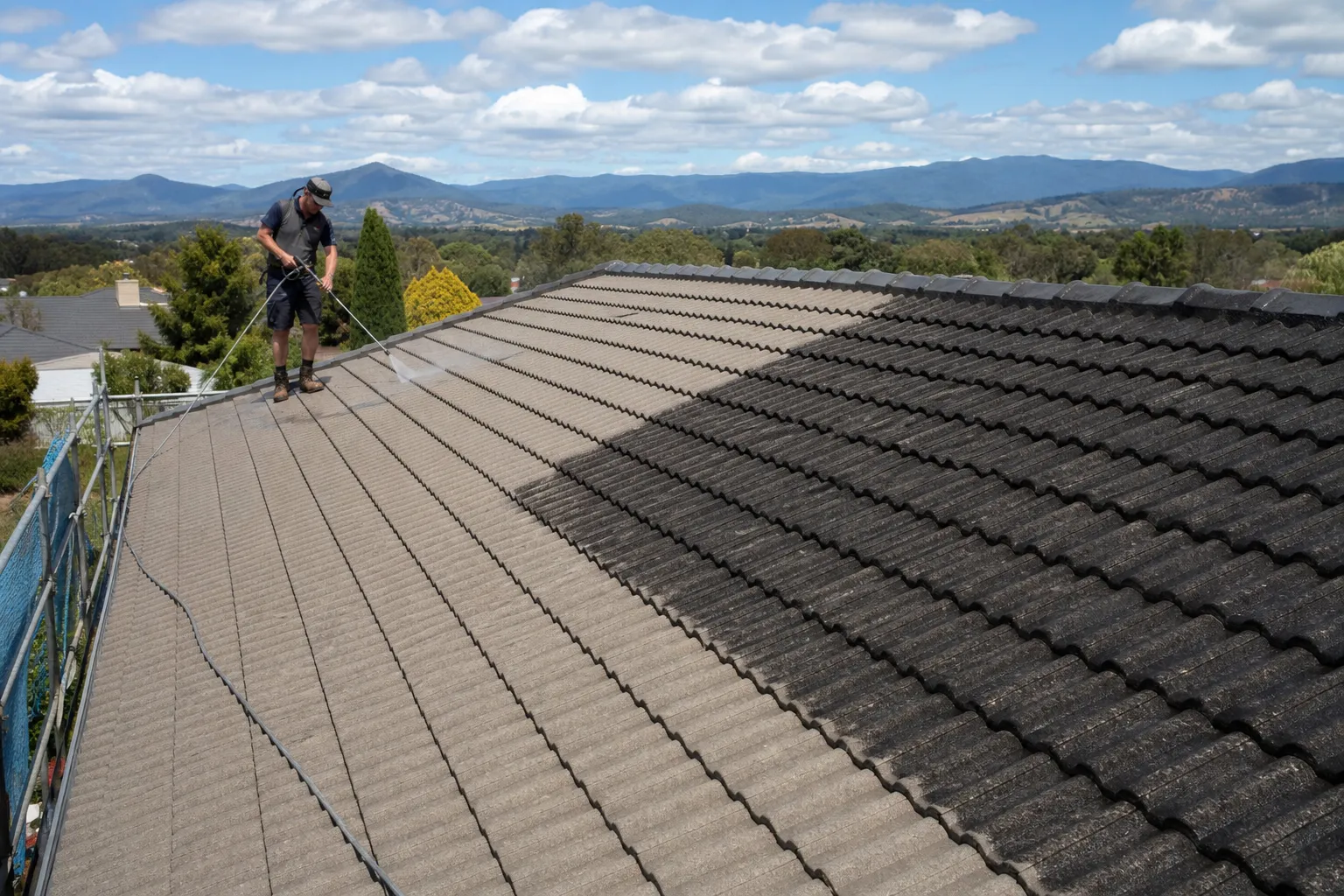
For reference, a full tile restoration runs in a set order: a high pressure clean back to a sound surface, broken tiles replaced and slipped ones re-set, ridge caps rebedded where the bedding has failed, flexible repointing along every ridge and hip, valleys and flashings sorted, gutters cleared, then a primer coat and the colour coats. Every step costs money. Every step skipped is a reason a cheap job peels or leaks within a winter or two.
Ridge capping is where a lot of the money goes
If you take one thing to the next quote, make it this. The ridge caps are the curved tiles that run along the peak and down the hips of a tile roof. They sit on a bed of mortar (the bedding) and are sealed along the edges with a finishing layer (the pointing). On most of the Canberra roofs we get up on, that's where the trouble starts.
Older roofs were pointed with a rigid sand and cement mix, and our winters are hard on it. Water gets in, freezes overnight, expands, and opens the cracks a little wider each time. After enough winters the pointing crumbles, the bedding underneath works loose, and the caps start to rock. That's usually when ridge leaks show up, often as a stain on a ceiling somewhere near the middle of the house.
There are two levels of fix, and they cost quite differently:
- Repointing only: the old pointing is cleaned off and new flexible pointing goes over the existing bedding. The cheaper option, and fine where the bedding is still solid.
- Rebedding and repointing: the caps come off, the old mortar is cleared, the caps are re-laid on fresh bedding and then repointed. More labour and more material, but it's the structural fix when caps are loose.
Ridge work is usually measured by the lineal metre. So a hipped roof with an L shape or a couple of wings costs more here than a simple gable roof over the same floor area. When you compare quotes, check whether each roofer is pricing repointing only or a full rebed, and over how many metres. That one line explains a lot of the gap between two prices.
We use a flexible pointing compound because it moves with the frost instead of cracking against it. Rigid pointing put back on a Canberra roof tends to fail the same way the original did, just sooner.
Restoration, repair or full replacement?
Part of getting the cost right is making sure you're paying for the correct fix in the first place. Not every tired roof needs a full restoration.
Straightforward roof repairs, like swapping a few cracked tiles or sorting one leak, generally run from a couple of hundred dollars up to a thousand or two, depending on the cause and how far the damage has spread. Repointing the ridge caps on their own sits a bit higher again. If the rest of the roof is sound, that targeted work is far better value than restoring the lot. We wrote a separate guide on telling repointing apart from a full restoration if you're weighing those two up.
A full restoration makes sense when the wear is everywhere at once, not in one spot. At the other end, if the roof is genuinely past saving, a full replacement is a different order of cost again, and a tile-to-Colorbond conversion in particular can run to $30,000 or more once the old roof is stripped and carted away. Most homes we look at don't need that. The point of getting a proper assessment is to land on the smallest job that actually solves the problem.
A fair Canberra quote shows its working
A price on its own tells you very little. What you want is an itemised quote you can actually read, so you can see what you're buying and compare two roofers on the same terms. A good one spells out:
- The clean, and how the roof is being cleaned (pressure or soft wash).
- How many tiles are being replaced, and whether replacements are included or charged as extras.
- Whether the ridge caps are being rebedded, repointed, or both.
- Whether rusted valley irons or tired flashings are being replaced before coating.
- The coating system: the primer or sealer, then how many colour coats go on.
- What the warranty covers, and for how long.
This is also where you protect yourself from the sales tactics people quietly warn each other about on the local forums. A roofer who's happy to give you a written, itemised quote after a proper look, with photos of what they found, is showing you their working. One who pressures you to sign on the day for a "today only" price is not. We start every job with a free roof restoration assessment and a photo report, so you can see exactly what your roof needs before you decide anything, and you're never quoted for work that isn't there.
Restoration is usually worth it, if the tiles are sound
For most Canberra homes, yes, provided the roof is a candidate for it. A restoration done properly buys back years of roof life for a fraction of what a full replacement costs. A sound restoration should hold up for well over a decade, and we back selected work with a warranty of up to 15 years, so it's not a patch-up that you'll be revisiting in two winters.
It's also worth thinking about what a neglected roof costs you the other way. Once water starts getting through failed pointing or cracked tiles, you're not just looking at roof work anymore. You're looking at sarking, ceilings, insulation and sometimes the frame. Restoring before that happens is almost always the cheaper path.
Time on site is shorter than most people expect, too. A typical restoration takes a few days, weather permitting, compared with a much longer strip and re-lay for a new roof. We do this work right across Canberra, from Gungahlin and Belconnen down to Tuggeranong, and over the border in Queanbeyan. The story is much the same in every district: frost on the ridges, sun on the coating, leaves in the valleys.
Is there a cheaper time of year?
People often ask whether they should wait for a quieter season to get a better price. In Canberra the bigger issue isn't price, it's the weather. Coatings need dry conditions and temperatures above a certain point to cure, so the depths of a frosty winter are the hardest time to get quality work done well. Spring and autumn tend to be the sweet spot. If your roof is already leaking, though, don't wait for a season. A temporary repair now beats water damage over the wettest months.
Nobody can price your roof from the street
Everything above is context to help you make sense of the quotes in front of you. The honest truth is that no one can price your roof accurately from the street or over the phone. Size, pitch, material and condition all pull the number in different directions, and the only way to pin it down is to get up there and look.
If you'd like a straight, itemised quote with photos and no pressure to sign anything, book a free roof restoration inspection with our team. The on-roof check usually takes about half an hour. We'll tell you whether it's a repair, a restoration or nothing yet, and give you a real figure for the work that's genuinely needed. A roof built Canberra-tough, frost and all.