If your Canberra roof is looking tired, you've probably heard two very different suggestions: some tradies will quote you a quick repointing job, others will push a full restoration. They're not the same thing, and they don't cost the same thing. Knowing which one your roof actually needs (and when the honest answer is "neither, not yet") can save you a lot of money.
This guide explains both, in plain terms, and gives you a safe way to form your own view from the ground before anyone climbs up.
Why Canberra roofs age the way they do
A huge share of Canberra's housing stock (much of Belconnen, Tuggeranong, Weston Creek and the older inner suburbs) went up through the 1970s and 80s on concrete tiles. Those tiles are tough, but the mortar holding the ridge and hip caps in place is the weak point, and Canberra's climate works on it harder than almost anywhere else in the country.
Our winters bring heavy frosts and sub-zero nights; our summers bring genuine heat. The old sand-and-cement mortar along your ridges is porous, so it drinks up moisture. When that water freezes overnight it expands, then thaws by mid-morning. Repeat that freeze-thaw cycle dozens of times each winter, add the daily expansion and contraction of summer heat, and the mortar slowly cracks, crumbles and lets go. On a roof that's forty or fifty years old and has never been touched, the bedding and pointing is often the first thing to fail, well before the tiles themselves.
What repointing actually is
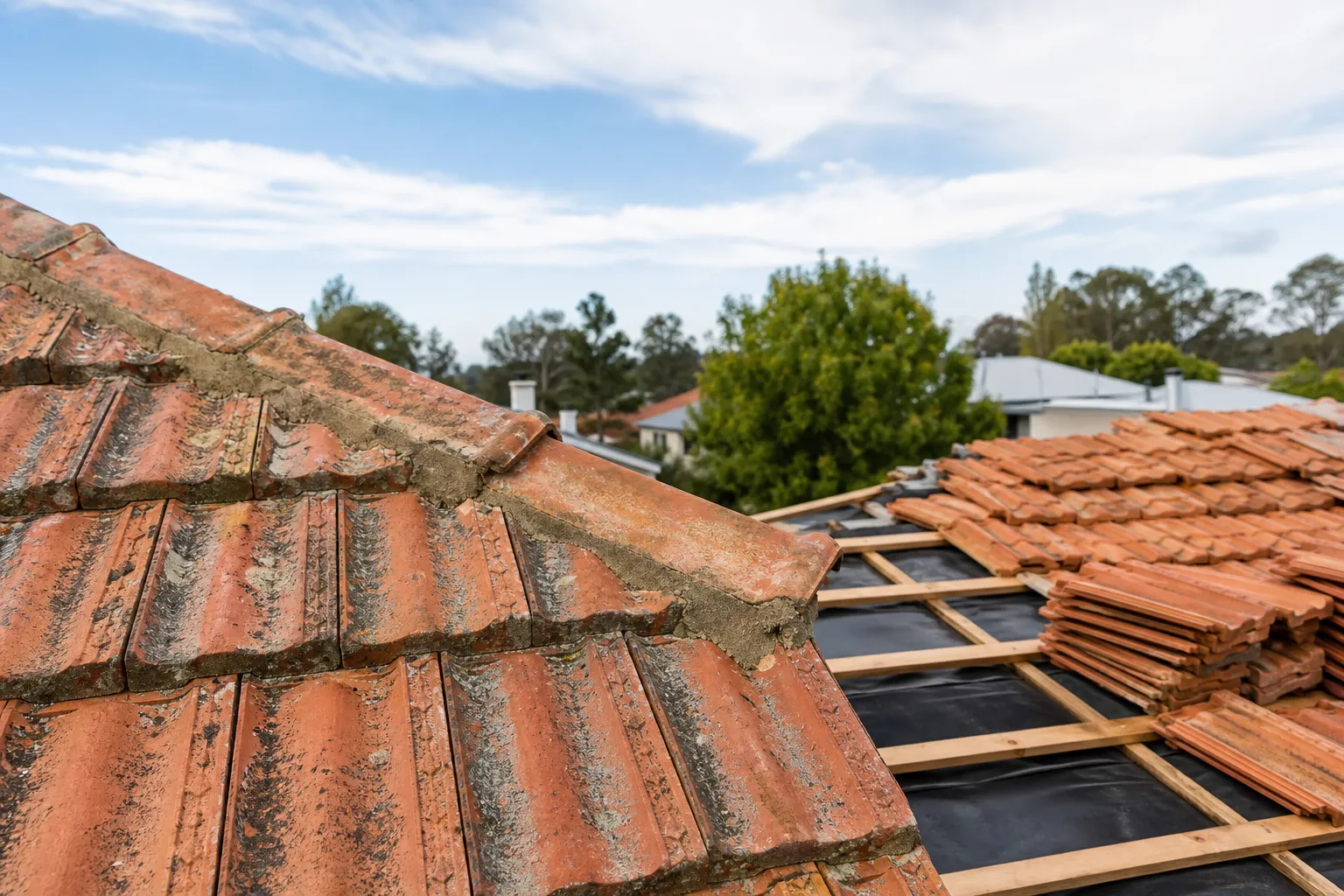
Pointing is the mortar layer you can see running along the ridge caps and hips. Repointing means raking out the old, cracked pointing and applying a fresh flexible pointing compound over the existing bedding. Modern flexible compounds move with the roof as it heats and cools, so they cope with Canberra's frost cycling far better than the rigid cement they replace.
Rebedding goes a step deeper: it means lifting the ridge caps, removing the crumbling mortar bed underneath, and re-laying the caps on a fresh bed before pointing over the top. If the caps themselves have come loose or the bedding has failed, you need rebedding and repointing together. Pointing alone won't hold.
Either way, this is targeted work on the ridges and hips. The rest of the tiled field is left as-is. That's the key distinction from a restoration.
When repointing alone is enough
Repointing (or rebedding and repointing) is the right call when the problem is confined to the mortar lines and the rest of the roof is sound. That usually means the tiles are in good shape (not widely cracked, not heavily eroded, not shedding grit), the roof isn't leaking, and the surface coating still has life in it. You're essentially maintaining an otherwise healthy roof by fixing its most exposed component before it lets water in.
This is the cheaper, less disruptive job, and if it's all your roof needs, a good roofer will tell you so rather than upselling you a full restoration.
What a full roof restoration involves
A roof restoration treats the whole roof, not just the ridges. A typical restoration includes a thorough clean to strip moss, lichen and built-up grime; replacing broken and cracked tiles; rebedding and repointing all the ridge capping; and then re-sealing and re-coating the entire tile surface with a protective coating system. The coat restores colour and, more importantly, re-seals porous, weathered tiles against water so the freeze-thaw cycle has less to work with.
It's a bigger job and it costs more, but it buys back years of roof life. The point of a restoration is to address a roof that's tired across the board, not to fix one failing part.
When a restoration is the smarter spend
Restoration makes sense when the wear is widespread rather than isolated. Signs that push a roof into restoration territory include tiles that have gone porous and are shedding grit into the gutters, faded or flaking surface coating across large areas, moss and lichen taking hold, multiple cracked or slipped tiles, and pointing that's failed along most of the ridge lines at once. When you'd be chasing failures all over the roof, patching each one in isolation becomes a losing game. Doing everything together, once, is better value.
Here's the practical difference between the two, side by side:
- Scope. Repointing: ridge and hip mortar only. Restoration: the entire roof surface plus the ridges.
- Best for. Repointing: a sound roof with failing pointing. Restoration: a roof that's tired and weathered across the board.
- Typical work. Repointing: rake out, re-bed if needed, apply flexible pointing. Restoration: clean, replace tiles, rebed and repoint, re-seal and re-coat.
- Disruption and cost. Repointing: lower, faster. Restoration: higher, but resets the roof's condition for years.
- What it doesn't fix. Repointing: porous or cracked tiles, faded coating, moss. Restoration: structural problems or a roof genuinely past saving.
A safe ground-level self-assessment
You can get a surprisingly good sense of where your roof sits without leaving the ground. Stay off the roof. Cold or mossy tiles are brittle and slippery, and a fall isn't worth it. From the yard, ideally with binoculars, and from the ground checking your gutters, run through this:
- Look along the ridge lines. Can you see gaps, crumbling mortar, or caps that look loose or slightly lifted? That points to a pointing or rebedding problem.
- Scan the tile field. Are tiles evenly coloured, or blotchy, faded and patchy? Widespread fading suggests the coating is spent.
- Check for moss and lichen. Green or grey-white growth, especially on shaded south-facing slopes, is a whole-roof issue.
- Look for obviously cracked or slipped tiles. One or two is a repair. A scattering across the roof leans towards restoration.
- Check the bottom of your downpipes and gutters. Lots of sandy grit or tile-coloured sediment means the tiles are eroding, a restoration signal.
- Check your ceilings inside. Any stains, especially after rain or a heavy frost, mean water is already getting in and you should book an inspection promptly.
If the only thing you can fault is the mortar along the ridges, you're likely looking at repointing. If several of these show problems at once, restoration is the more honest answer. And if you genuinely can't find anything wrong (sound tiles, tidy pointing, clear gutters, dry ceilings), then good news: you probably don't need us yet. Book an inspection in a year or two and keep your gutters clear in the meantime.
Still not sure? That's normal
Plenty of Canberra roofs sit in a grey area, and the difference between "repoint it" and "restore it" comes down to details you can only judge up close: how porous the tiles really are, and how far the bedding has gone. That's what an on-roof look settles. Our team also handles straightforward roof repairs when it's just a couple of tiles, and full roof replacement in the rare cases a roof is genuinely past restoring, so the recommendation you get isn't tied to selling one particular job.
If your ridges are looking crumbly, your tiles are fading, or you just want a clear read on where your roof stands before the next winter, book a roof inspection. You'll get an honest assessment with photos and a straight answer on whether it's repointing, restoration, or nothing yet: a roof built Canberra-tough, frost and all.