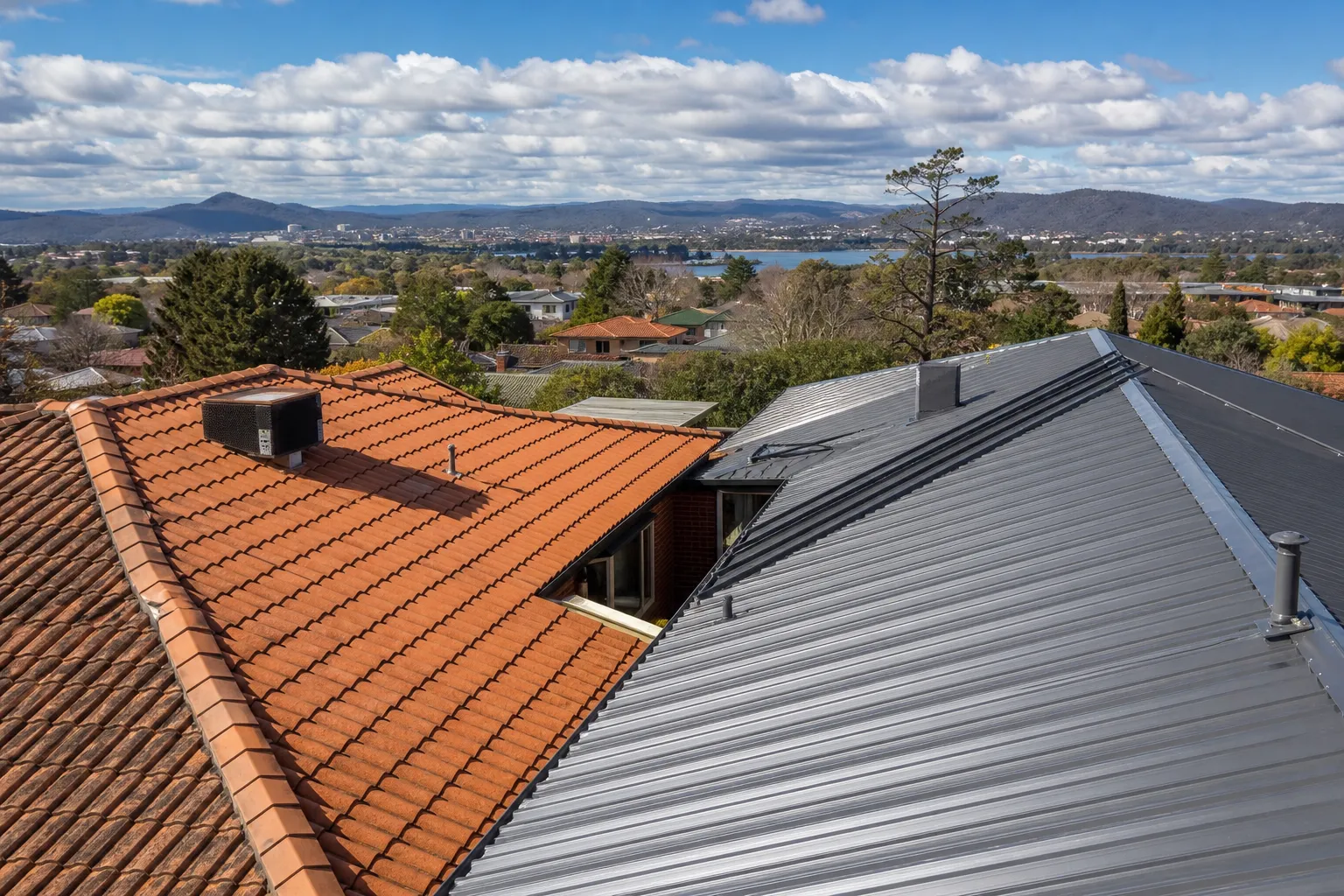
Plenty of Canberra homeowners hit the same fork in the road: the old tile roof is tired, and you're weighing whether to keep and restore the tiles or strip them off and go to Colorbond steel. It's a genuine decision with real trade-offs, and the right answer depends on your house, your budget and, more than most people realise, Canberra's climate.
This guide walks through both options honestly, without pushing you toward the bigger job. Neither material is "best" in the abstract; one of them is simply a better fit for your situation.
Why this question comes up so often in Canberra
A large share of Canberra's housing stock (much of Belconnen, Tuggeranong, Weston Creek and the established inner suburbs) was built through the 1970s and 80s on concrete tiles. Those roofs are now forty to fifty years old, which is exactly when the mortar bedding fails, the surface coating wears off and the tiles turn porous. So a whole generation of Canberra homes reaches its re-roof decision at roughly the same time.
Our climate sharpens the choice. Heavy frosts, sub-zero nights, real summer heat, the odd hailstorm and occasional snow all work on a roof harder here than in most Australian cities. That matters, because the two materials cope with those conditions in very different ways.
The case for keeping (and restoring) your tiles
If your tiles are structurally sound, restoring them is usually the cheaper, less disruptive path. A concrete or terracotta tile roof that's simply weathered can often be cleaned, have broken tiles swapped out, be rebedded and repointed, then re-sealed and coated, bringing it back to life without the cost and upheaval of a full re-roof. If you're not sure whether yours qualifies, our guide to repointing versus restoration helps you tell.
Tiles have some real advantages worth keeping in mind:
- Lower upfront cost. Restoring existing tiles, or re-laying with tiles, generally costs less than a full switch to steel, because you're not removing and replacing the entire roof structure.
- Thermal mass. Heavy tiles absorb heat slowly and release it slowly, which can help even out temperature swings, useful in a climate with hot days and cold nights.
- Quieter in rain and hail. Tiles naturally dampen the sound of heavy rain and hail on the roof.
- Traditional look. On a period or brick-and-tile home, tiles keep the character that suits the street.
The catch is maintenance. Tile roofs need periodic attention: repointing the ridge caps, replacing the odd cracked tile, re-coating every so often. In Canberra's frost that upkeep cycle comes around a little faster.
The case for switching to Colorbond
Colorbond steel has become the default for many re-roofs, and for good reasons. It's the material we fit most often when a Canberra tile roof is genuinely past restoring rather than just weathered.
- Light weight. Steel sheeting is a fraction of the weight of concrete tiles. That's a real plus on older homes, and it simplifies the structure.
- Fewer joints, fewer leak points. Long sheets run from ridge to gutter with far fewer overlaps than hundreds of individual tiles, so there's less for wind-driven rain to get under.
- Low maintenance. No mortar to crack, no pointing to redo. An occasional wash and the odd flashing check is usually all it asks.
- Wind and storm resistance. Sheets are screwed continuously to the frame, so they hold up well when the weather turns.
- Solar-friendly. Panel brackets fix straight to the steel, which makes a future solar install simpler than working around tiles.
- A fresh look. A new steel roof in a modern colour visibly lifts a tired house.
If you're leaning this way, our metal roofing and roof replacement pages cover how a tile-to-Colorbond conversion actually runs: old roof off, batten and structure checked, new sheeting and flashings on.
How Canberra's climate tips the scales
This is where the local picture matters more than a generic pros-and-cons list.
Frost and freeze-thaw
Canberra's overnight frosts are hard on tiles. Porous, weathered tiles and old mortar soak up moisture; when it freezes it expands, then thaws by mid-morning. Repeat that freeze-thaw cycle dozens of times each winter and the bedding, pointing and eventually the tiles themselves break down. Steel doesn't absorb water, so it sidesteps that particular failure mode entirely, one reason Colorbond ages well in our winters.
Condensation and sarking
Metal roofs have one cold-climate quirk worth knowing: on frosty Canberra nights the underside of the steel can get cold enough for condensation to form. It's a solved problem, not a dealbreaker. The fix is proper insulation and reflective sarking under the sheets, which any competent re-roof here should include as standard. Skip it and you can get drips that look like a leak; do it right and you never notice.
Hail, heat and noise
Canberra's occasional hail can dent both materials and crack brittle tiles. Rain and hail are louder on steel, though sarking and insulation take the edge off. In summer heat, tile's thermal mass and steel's quick cool-down each have their fans. With good ceiling insulation, the practical difference inside is smaller than the online debates suggest.
Cost and disruption: what to expect
As a rule of thumb, restoring a sound tile roof is the lightest spend, re-laying with new tiles sits in the middle, and a full tile-to-Colorbond conversion is the largest upfront cost, because it involves stripping the old roof, checking and adjusting the structure, and installing an entirely new system with sarking and flashings. Against that higher upfront figure, Colorbond's low maintenance can even things out over the decades you own the home.
Every roof is different, so treat those as directions rather than quotes. The only reliable number comes from someone looking at your actual roof. Beware of any figure quoted without an inspection.
A quick way to decide
Use this as a starting point, then confirm with an inspection:
- Restore your tiles if the tiles are structurally sound and just weathered, you like the traditional look, and you'd rather spend less now.
- Go to Colorbond if the tiles are cracking or crumbling across the roof, you want the lowest ongoing maintenance, you're planning solar, or you want a modern look.
- Get advice either way if you're seeing leaks, sagging, or widespread failure, as that changes the maths, and guessing is expensive.
Common questions
How long does a Colorbond roof last?
A well-installed steel roof typically lasts for decades with minimal upkeep. Coastal salt air shortens that elsewhere, but inland Canberra is a kind environment for steel.
What's the downside of Colorbond?
Higher upfront cost than restoring tiles, more rain noise, and the condensation point above, all manageable with the right build, but worth knowing before you commit.
Can any tile roof be converted to Colorbond?
Almost always, yes. The structure occasionally needs minor adjustment to suit the lighter sheeting, which a roofer checks before quoting.
Get a straight answer for your roof
The honest recommendation depends on climbing up and looking: how porous your tiles really are, how the bedding has held up, and what your frames need. Book a roof inspection and you'll get a photo report and a clear read on whether restoring your tiles or switching to Colorbond is the smarter move for your home: a roof built Canberra-tough, hail, frost and all.