There's a bucket in the hallway and it's been raining since lunch. Every few seconds you hear the drip, and the question going through your head isn't really about the roof. It's about money. How much is this going to cost to fix?
Roof leak repair cost in Canberra covers a wide range, and we won't pretend otherwise. A single cracked tile and a rusted-out valley are both "a leak", but they are very different jobs. What we can do is explain what actually sets the price, so the quote you get makes sense and you can tell whether it's fixing the problem or just covering it.
Nobody can honestly price a leak over the phone
We get asked for a number on the phone all the time, and we understand why. The trouble is that the drip in your ceiling tells us very little about where the water is getting in.
Water rarely comes through the roof directly above the wet patch. It gets in at one point, runs along a batten or across the sarking (the foil layer under the tiles), and drips down wherever it finds a low spot. We regularly find the real entry point a couple of metres away from the stain. If you're still at the stage of working out how serious your stain is, our guide to what a ceiling water stain is telling you covers that part.
So the first part of any leak repair is finding the cause. Until someone has been up on the roof and found it, any figure is a guess.
The cause sets the price more than anything else
Once the source is found, most leaks on Canberra roofs fall into a handful of types. They sit on a rough scale from quick fix to proper job.
A cracked or slipped tile
This is usually the smallest repair. Canberra's frost works its way into hairline cracks, and summer hail finishes off tiles that have gone brittle with age. Swapping a broken tile, or resetting one that has slipped, is often done in a single visit. The cost goes up if replacement tiles are hard to match on an older roof, or if more tiles turn out to be cracked than the one you knew about.
Ridge pointing and bedding
The ridge caps along the top of a tile roof sit on bedding mortar and are sealed with pointing. Old rigid pointing cracks with our freeze and thaw winters, and once it goes, wind-driven rain gets straight under the caps. Repointing a short section is a modest job. If the bedding has failed along every ridge and hip, it becomes a much bigger one, because each cap has to come off, be rebedded and be pointed again.
Valleys and flashings
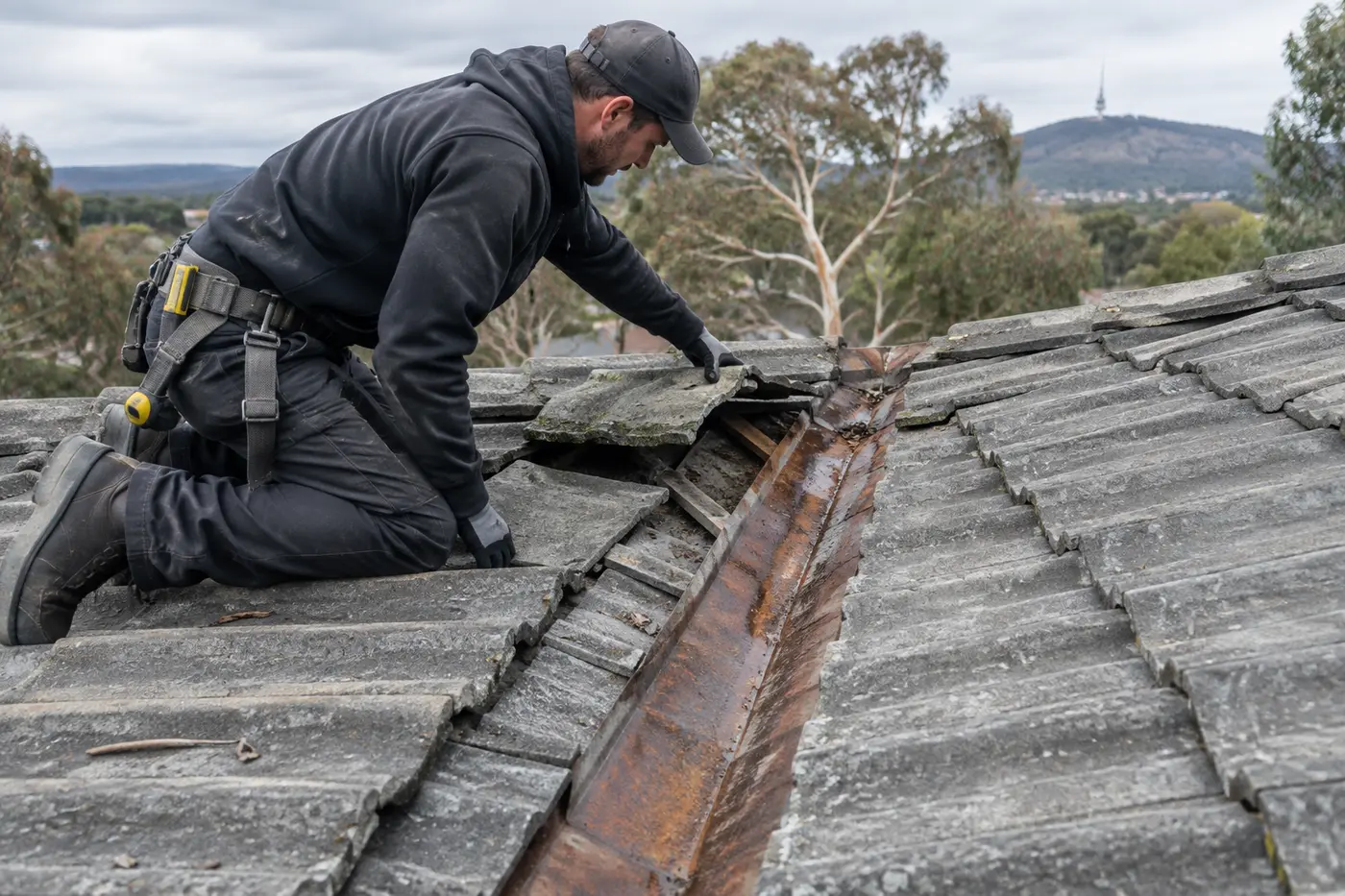
Valleys are the metal channels where two roof slopes meet. Flashings are the metal or sealed strips around chimneys, skylights, vents and walls. Both are common leak points, and they're often where we find the problem on homes with big trees nearby, because leaf litter sits in the valley and holds moisture against the steel until it rusts through.
Fixing a valley properly means lifting the tiles along both sides, replacing the valley iron and relaying the tiles. That's more labour than swapping a tile, and the length of the valley largely decides the cost.
Fasteners on a metal roof
On Colorbond and other metal roofs, the steel itself is rarely the issue. The rubber washers under the roofing screws perish, typically around the 15 to 25 year mark, and water weeps in around them. If it's a handful of screws in one spot, it's a small repair. If the washers have gone across the whole roof, the honest fix is re-screwing all of it, which is priced by the size of the roof rather than by the leak.
Gutters that overflow
Sometimes the "roof leak" isn't the roof at all. A blocked or undersized gutter overflows in heavy rain, and the water backs up under the edge of the roof and into the eaves or the wall. Clearing or fixing the gutter can solve it for much less than anyone expected. This one surprises people, and it's a good reason to have the cause confirmed before agreeing to roof work.
What pushes the price up, whatever the cause
Two leaks with the same cause can still be priced differently. These are the usual reasons.
Access and height. A single storey home with an easy, low pitched roof is quicker and safer to work on. A steep roof or a second storey needs more safety equipment, and sometimes scaffolding or edge protection, before anyone can start.
How long it's been leaking. A leak caught in the first week is a roof job. One that has run through a whole Canberra winter can mean soft battens, damaged sarking and soggy insulation as well. The roof repair can be the smaller part of the bill by then, and ceiling repairs are often quoted separately, so ask what the quote covers.
Whether it's urgent. If water is pouring in and more rain is coming, the first visit may be about making the roof watertight quickly. The permanent repair then follows once the weather allows. That's sometimes two visits instead of one, and it's the right call when the alternative is a ceiling coming down.
Age and condition of the rest of the roof. On an old roof, walking on tiles to reach the leak can crack others that were already fragile. A careful roofer allows for that and tells you about it up front.
How we price a leak repair
Our approach is straightforward. Small repairs are quoted on the spot, once we've found the cause and can show you what it is. Larger jobs, and anything storm related, get a written fixed quote, along with an insurance report where one is needed. Urgent leaks are prioritised, and we get you watertight first and sort out the detail after.
Our roof inspections are free and come with a photo report, so you can see the cracked pointing or the rusted valley for yourself rather than taking our word for it. The point of our roof leak and storm repair work is to fix the cause once, not to keep coming back to the same patch of ceiling. As licensed roof plumbers (ACT Roof Plumber Licence 242220C), the valleys, flashings and fasteners behind most leaks are work we do every week.
The cheapest fix can end up costing more
A tube of sealant smeared over a crack or around a flashing is the cheapest repair there is. Sometimes it holds for a season. Often it doesn't, because the real problem was a rusted valley or perished washers underneath, and the water simply finds a new way in a metre along.
The pattern we see most is three or four small repairs over a few years, each one cheap, which add up to more than fixing it properly would have cost the first time. When you compare quotes, a slightly higher price that replaces the failed part is usually better value than a low one that seals over it.
There's also a point where repairs stop making sense. If leaks keep turning up in different spots, the pointing is failing along every ridge and the tiles are going porous, the roof has usually reached the end of its surface life. A string of repairs at that stage is money spent on a roof that needs more. We'll tell you if we think that's where yours is, with photos, and our guide to pricing a roof restoration in Canberra explains what that bigger job involves.
Four things to check on any leak repair quote
Before you say yes to a quote, from us or anyone else, make sure it tells you:
- what is actually causing the leak, in plain words
- what is being replaced, and what is only being sealed
- whether this visit is a temporary fix or the permanent repair
- what warranty applies, and that it's in writing
If a quote can't answer the first question, the roofer hasn't found the leak yet. We back selected work with a warranty of up to 15 years (conditions apply), and we'll tell you up front whether your repair is covered.
Get a real price for your leak
If there's a drip in your ceiling right now, the cheapest moment to fix it is before the next big rain. Book a free inspection and we'll find where the water is getting in, show you the photos and give you a price for repairing the leak properly. Call (02) 6109 5008.