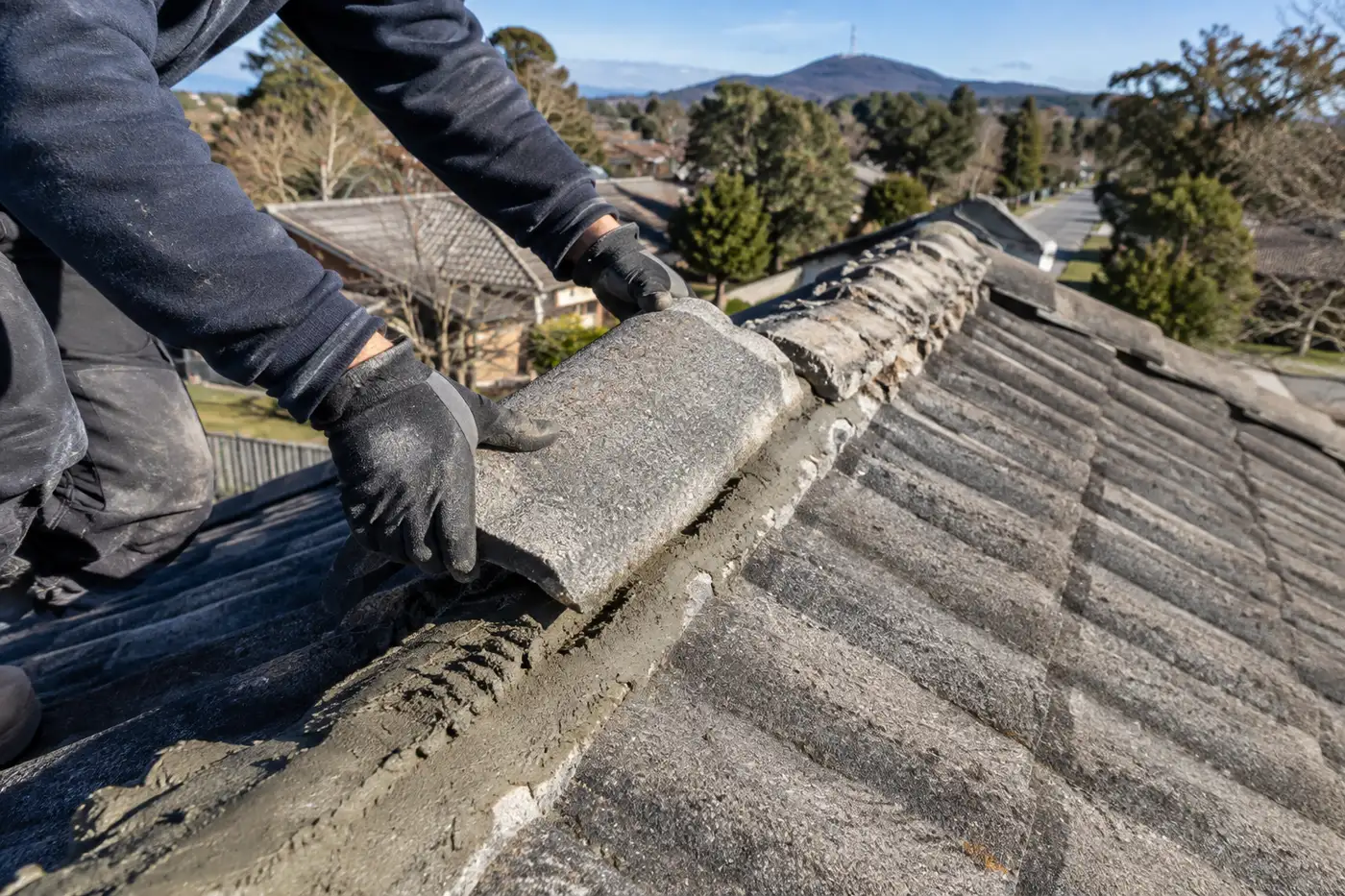
It usually starts with a few crumbs of grey mortar in the gutter, or a neighbour pointing out that one of your ridge caps looks a bit crooked. Then a roofer comes out, says the ridges need doing, and gives you a number. The obvious next question is whether that number is fair. Ridge capping repair cost is one of the harder roofing prices to judge from the ground, because the same few words on a quote can describe two very different jobs.
This guide explains what you're actually paying for when the ridges on a Canberra tile roof get fixed, why two quotes for the "same" work can be so far apart, and what to ask before you sign anything.
The ridge is the part of a tile roof that fails first
Ridge caps are the curved tiles that run along the peak of the roof and down each hip (the sloping corners on a hipped roof). Unlike the flat tiles, which hook over timber battens, the caps sit on a bed of mortar called the bedding. Along the edges of each cap there's a finishing layer called the pointing, which seals the joint and stops rain getting underneath.
On older Canberra roofs that bedding and pointing is plain sand and cement. It's rigid and slightly porous. Water soaks in, freezes on a frosty night, expands, and opens up hairline cracks. By mid-morning it thaws, and the next night it happens again. After enough winters the pointing crumbles away and the bedding underneath starts to let go. The tiles themselves are often fine. It's the mortar holding the caps on that gives up.
Most of the roofs we look at across Belconnen, Woden, Weston Creek and Tuggeranong went up through the 1970s and 80s, so many of them are now on their original ridge mortar. That's why this is one of the most common jobs we quote.
Two different jobs, two very different prices
The single biggest thing that sets ridge capping repair cost is which of these two jobs your roof needs. Everything else is detail.
Repointing only
If the bedding underneath is still solid and the caps don't move when pressed, the fix is repointing. The old, cracked pointing is raked or cleaned back, and a new layer of flexible pointing compound goes over the top. Flexible compound is the important part for Canberra. It moves a little as the roof heats and cools, so it copes with frost far better than the rigid cement it replaces.
Repointing is the cheaper of the two. The caps stay where they are, there's less material, and the job moves along the ridge fairly quickly.
Rebedding and repointing
If the caps rock, have shifted out of line, or have already blown off in a storm, pointing over the top won't hold. The caps need to come off. The old bedding is cleared away, the caps are relaid on fresh bedding, then the new flexible pointing goes on.
Every cap gets handled twice, and there's more material and the cleanup of the old mortar. It costs noticeably more per metre than repointing alone. It's also the structural fix, and on a roof where the bedding has failed, it's the only one that lasts.
This is the most common reason quotes differ. One roofer may quote a repoint, the other a rebed and repoint, and both might call it "ridge capping repairs" on the paper. Before you compare prices, check which job each quote is actually for.
What else moves the number
How many lineal metres of ridge you have
Ridge work is normally priced by the lineal metre, so the length of ridges and hips on your roof matters more than the floor area of the house. A simple gable roof has one straight ridge along the top. A hipped roof has that ridge plus four hips running down to the corners. An L shaped or U shaped house with a few wings can double the metres again. Two homes with the same floor area can end up with very different ridge totals.
Whether the whole roof or one section needs doing
Sometimes the damage is local: one hip on the southern side that never gets the sun, or a run of caps that lifted in a storm. Fixing just that section is a smaller job. But if the pointing has failed on one ridge, the rest is usually the same age and has been through the same winters. A good roofer will tell you honestly whether a partial repair makes sense or whether you'd just be paying twice.
Broken or missing caps
Caps that cracked when they lifted, or smashed when they hit the ground, need replacing. On a newer roof that's simple. On an older one, finding a cap that matches the profile and colour can take some searching, and salvaged stock may be the only option. Terracotta caps on older Inner North and Inner South homes can be harder to match than common concrete profiles.
Pitch, height and access
A steep roof needs harnesses and edge protection and slows the whole job down. Two storeys take longer to set up safely than one. Trees overhanging the ridge, power lines nearby or a tight side path for getting materials up all add time, and time is most of what you pay for in ridge work.
Colour matching
Flexible pointing comes in a range of colours. If the rest of the roof isn't being coated, the pointing needs to blend with the existing tiles. That's not usually a big cost factor, but it's worth checking the quote mentions it so you don't end up with bright new stripes on a faded roof.
Why we don't put a dollar figure on it here
We could print a per metre price and you'd have a number. The trouble is that the number only means something once someone has counted your metres and checked whether the caps move. Two homes on the same street can come out very differently once you account for hips, pitch and how far the bedding has gone.
What we can say is the general shape of it. A targeted ridge repair on a roof that's otherwise sound is far cheaper than restoring the whole roof. A repoint costs less than a rebed and repoint. And leaving failing ridges until they leak usually turns a ridge job into a ridge job plus ceiling repairs. If you want a feel for how ridge work fits into the bigger picture, our guide to tile roof restoration prices in Canberra shows where it sits inside a full restoration quote.
How to tell whether a ridge quote is fair
A fair quote shows its working. When we price ridge work, we quote a fixed price after we've been on the roof, and these are the things worth seeing written down on any quote you get:
- The total lineal metres of ridge and hip being done
- Whether it's repointing only, or rebedding and repointing (and if both, which sections)
- How many caps are being replaced, and whether that's included or extra
- The pointing product, and confirmation it's a flexible compound rather than cement
- Whether the old mortar is cleaned out properly before new work goes on
- Photos of the ridges as they are now
Photos matter more than people think. If a roofer says your bedding has failed, you should be able to see the loose caps and crumbling mortar in the pictures. Our free inspections come with a photo report for exactly that reason.
Watch for a quote that says "repoint" when the caps are visibly loose. It will be cheaper, and it will look good for a season, but pointing laid over failed bedding cracks again within a winter or two. Pay a bit more for the right job once.
Ridge repair or something bigger?
Sometimes the ridges are the whole story. Sometimes they're just the first thing you noticed. If the tiles are also faded and shedding grit, there's moss across the shaded faces, and several tiles are cracked, fixing only the ridges can mean chasing failures around the roof for years. At that point a full restoration, which includes rebedding and repointing every ridge anyway, can be the better value.
We wrote a separate guide on deciding between repointing and a full restoration with a simple self check you can do from the yard. Please don't climb up to look. Mortar crumbs, a bent ridge line and a damp patch on a ceiling near the middle of the house are all things you can spot from the ground or from inside.
Timing matters more than you'd think
Pointing compound needs dry conditions to cure, and Canberra winters don't help. A ridge that's been cracking slowly for years will often give up during the first heavy frosts, or get stripped in a summer storm when the bedding is already loose. If you can see problems now, getting the ridges done in spring or autumn is far easier than calling us out with a cap sitting in the garden bed and rain on the way.
Our team is licensed (ACT Roof Plumber Licence 242220C), and selected services carry a 15-year warranty, with conditions applying. If your ridges are looking tired, book a ridge and pointing repair inspection and we'll tell you whether you need a repoint, a rebed, or nothing yet, with photos to show why.