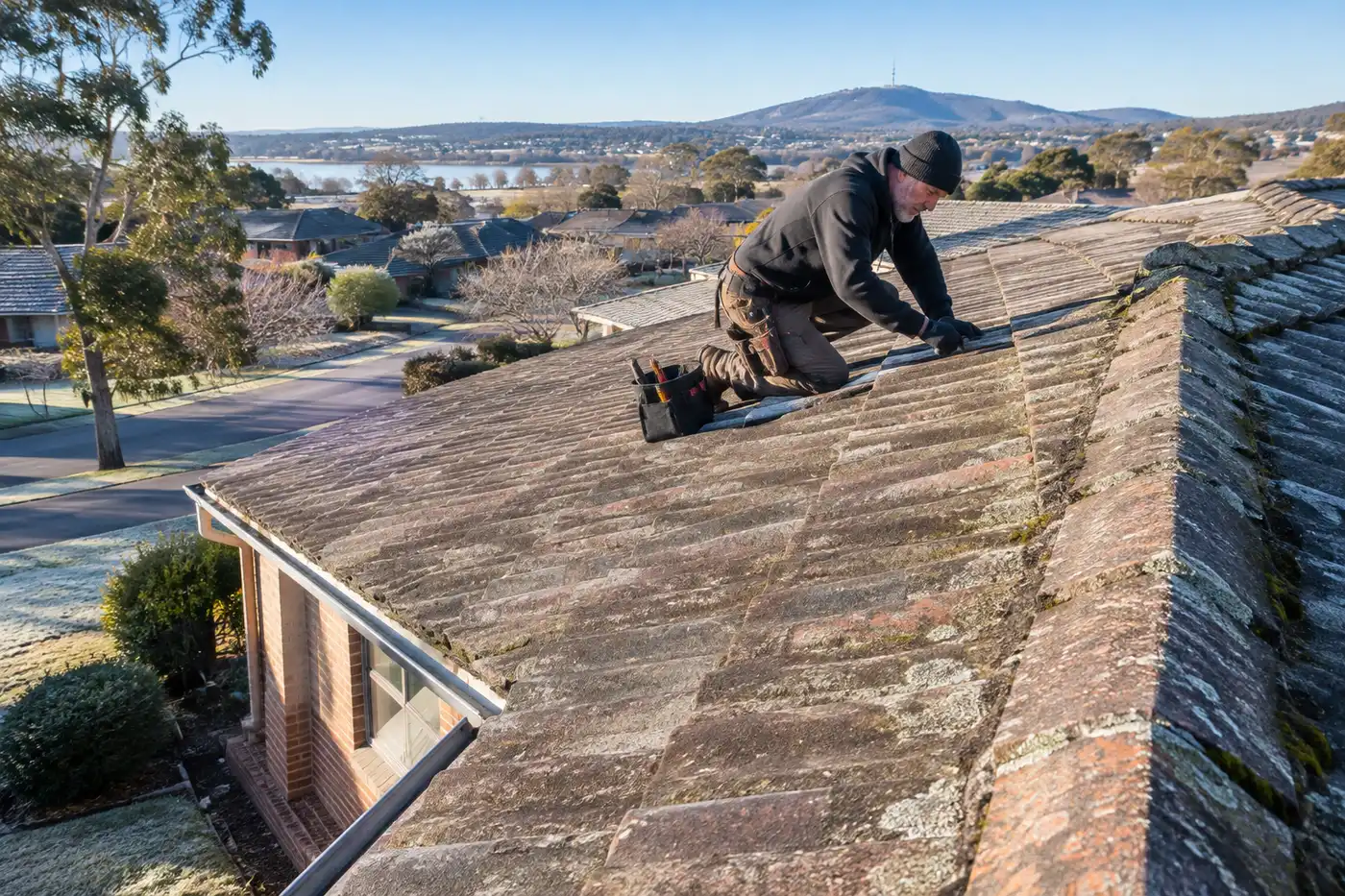
You're halfway through buying a brick veneer in Kambah, and the building report says the roof is "nearing the end of its serviceable life". Or you've owned the place for years, the tiles have gone patchy, and someone has knocked on the door to tell you it needs replacing. Either way the question is the same: how long does a tile roof last, and how much life is left in yours?
The honest answer is that the tiles themselves usually last a very long time. It's everything holding them in place and keeping the water out that gives up first. Canberra's frosty winters speed that along. Here's what ages on a tile roof, how to get a rough idea of where yours sits, and how to tell a tired roof from one that is genuinely finished.
The tiles usually outlast everything around them
A tile roof isn't one thing. It's the tiles, plus the mortar along the ridges and hips, the metal valleys where two slopes meet, the flashings against walls and chimneys, and the timber battens the tiles hang from. Each of those parts has its own lifespan.
The tiles are the toughest of the lot. Many of the concrete tile roofs we look at in Belconnen are now 40 to 50 years old, and in Woden Valley plenty of original roofs are well past 50. Most of those tiles are still up there doing their job. What has usually failed is the stuff around them.
So when someone asks us how long their roof will last, we find a better question is this: which parts have worn out, and are the tiles still sound enough to be worth keeping?
What wears out first on a Canberra tile roof
The ridge bedding and pointing
The ridge and hip caps (the rounded tiles along the peaks and edges) sit on a bed of mortar, finished with a layer of pointing over the top. Old sand and cement mortar is porous, so it soaks up water. On a frosty night that water freezes, expands and opens up hairline cracks, then thaws by mid morning. Repeat that dozens of times each winter for a few decades and the mortar crumbles, the caps loosen and rain finds its way in along the ridge.
This is the most common repair we do on both concrete and terracotta roofs. It's usually the first real sign a roof is ageing.
The surface coating on concrete tiles
Concrete tiles are coloured on the surface, and that coating is what keeps water out. Over time it wears away. The colour goes chalky and patchy, and the tile starts absorbing moisture. A porous tile stays damp, grows moss and lichen, and breaks down faster in frost. Terracotta is fired clay and absorbs far less water, so it doesn't lean on a coating in the same way.
Valleys and flashings
Valley irons are the folded metal channels where two roof slopes meet. On older homes they're often galvanised steel, and wet leaf litter sitting in them for weeks wears through the zinc until the steel rusts. Flashings, the metal strips that seal the roof against walls, chimneys and skylights, also tend to age well ahead of the tiles beside them.
Cracked and slipped tiles
Hail, falling branches and anyone who has walked up there to fix a TV aerial all leave cracked tiles behind. One or two is a simple swap. Dozens across every face is a different story, and it's one of the things that pushes a roof toward replacement.
Concrete and terracotta wear out in different ways
Most Canberra homes have one or the other, and they don't age the same way. Concrete tiles are strong but depend on that surface coating, so once it's gone they need sealing and recoating to keep going. Terracotta copes with freeze and thaw better as a material, but it's more brittle. For terracotta, cracking from hail or foot traffic is the bigger risk. Original terracotta on older homes is often still sound after a very long time, provided the mortar and valleys have been looked after.
Not sure which you have? Our guide to telling concrete and terracotta tiles apart shows you how to check from the ground, and why the right restoration differs between them.
Your suburb is a rough guide to your roof's age
Canberra was built in waves, so the age of a suburb says a fair bit about what's on top of the houses. Treat it as a rule of thumb only, because plenty of homes have been re-roofed since.
- Inner North and Inner South (Ainslie, Braddon, Reid, Forrest, Red Hill): homes from the 1920s to the 50s, many still on original terracotta
- Woden Valley: built largely in the 1960s and 70s, a mix of concrete and terracotta, with many roofs well past 50 years
- Belconnen: built out through the 1970s and early 80s, mostly concrete tile, now commonly 40 to 50 years old
- Tuggeranong: mainly 1980s and 90s brick veneer under concrete tile, with many roofs due for a first or second restoration
Homes in newer areas like Gungahlin and Molonglo Valley are much younger, so most are still years away from the problems above.
A restoration renews the parts that wear out
If the tiles are sound, you usually don't need a new roof. You need the worn parts renewed. A full tile restoration does exactly that: a clean back to a sound surface, broken tiles replaced, ridge caps rebedded where the bedding has failed, fresh flexible pointing along every ridge and hip, valleys and flashings sorted, then primer and colour coats on tiles that need them.
Done properly, a restoration adds roughly 10 to 15 years to a tile roof for a fraction of what replacement costs. Most of the roofs we restore are concrete or terracotta, somewhere between 20 and 50 years old, and have never been touched. That's the sweet spot. You can see how the work runs on our tile roof restoration page, and we back selected work with a warranty of up to 15 years (conditions apply).
One caution for older homes. Original terracotta is usually better cleaned, repointed and repaired than coated, so the right job really does depend on the tile.
Signs your tiles are genuinely finished
Sometimes restoration isn't the right call. Coating a roof whose tiles are breaking down only buys a short reprieve. These are the things that tell us a roof is at the end rather than just tired:
- concrete tiles so porous they're crumbling and shedding grit into the gutters
- cracked or broken tiles on every face, not just a handful
- soft or split battens from years of slow leaks
- leaks that keep coming back after earlier repairs
If several of those apply, replacement is often better value than putting money into a restoration. Our breakdown of what a new roof costs in Canberra covers what sets that price, including switching from tile to Colorbond.
You can't judge it from the driveway
Faded colour and a bit of moss look alarming from the street but often mean very little. Cracked pointing and a rusting valley are hard to see from the ground, yet they matter a lot. The only reliable way to know how much life is left is for someone to get up there and look at the tiles, the mortar and the valleys, and check the timbers from inside the roof space where we can.
Please don't climb up to check it yourself. Old tiles crack underfoot and can be slippery even when dry. We'd suggest an inspection if your roof is past 20 years and has never been assessed, after a big hailstorm, or before you buy or sell. Ours are free and come with a photo report, so you see exactly what we saw.
If your tile roof is getting on and you'd like a straight answer on whether it needs restoring, repairing or replacing, book a free inspection on (02) 6109 5008. We're licensed roof plumbers (ACT Roof Plumber Licence 242220C), and you can read more about how we restore Canberra tile roofs before we come out.