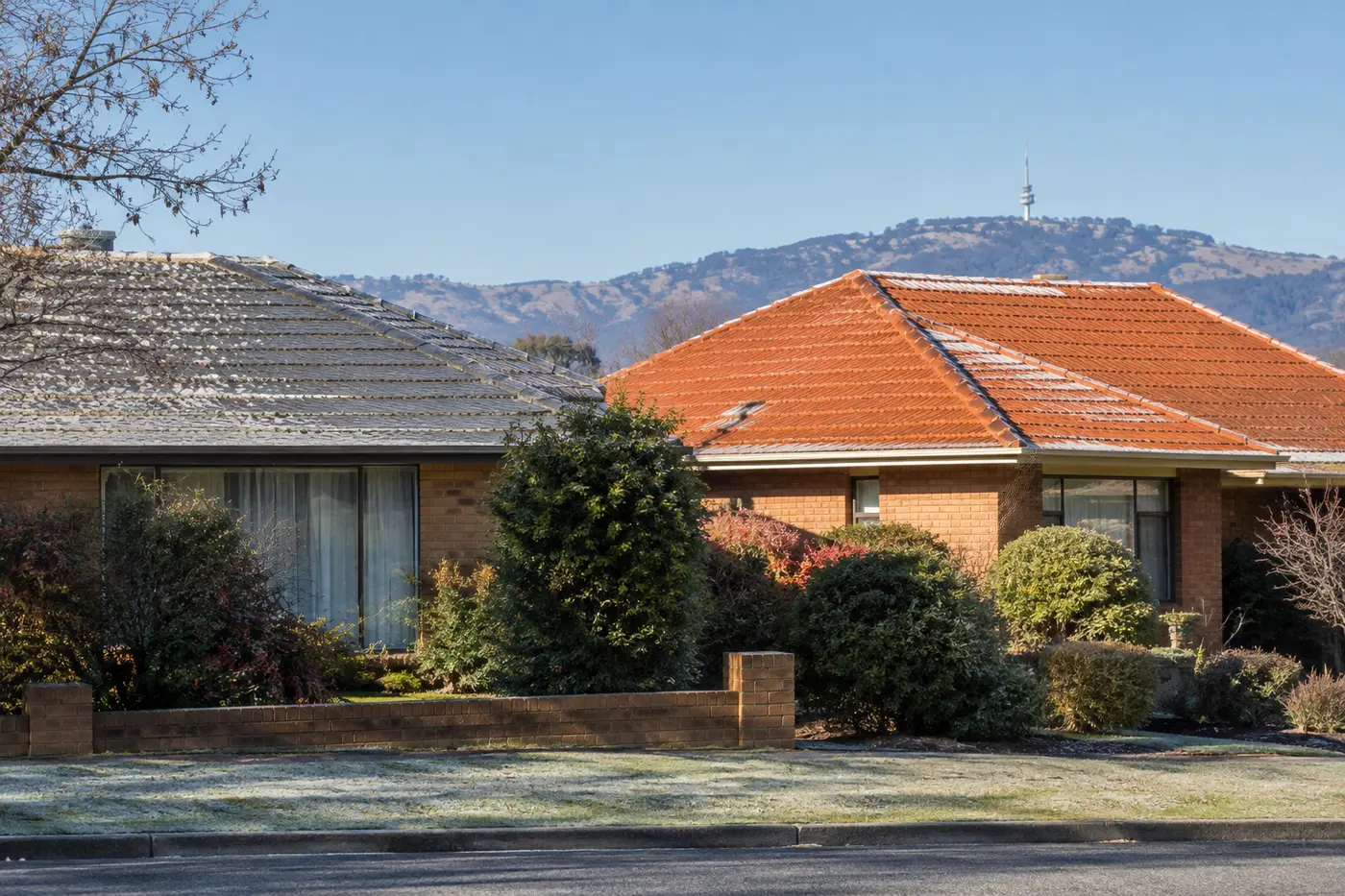
We get this call a lot. Someone has bought a brick home in Hawker or Lyneham, the roof is looking tired, and every quote they've had seems to assume a different kind of tile. One roofer talks about sealing and recoating. Another says it should never be painted. The owner just wants to know what's actually up there and what it needs.
So here is how concrete vs terracotta roof tiles really plays out on Canberra homes. Which one you probably have, how each copes with our frost, and why the right restoration for one can be the wrong one for the other.
Most Canberra homes can be dated by their tiles
The age of a suburb tells you a lot. The Inner North and Inner South, places like Ainslie, Braddon, Reid, Forrest and Red Hill, carry homes from the 1920s to the 50s, and many still have their original terracotta. Woden Valley was built largely in the 1960s and 70s, and you'll find both concrete and original terracotta there, with many of those roofs now well past 50 years.
Then came the big expansion. Belconnen was built out through the 1970s and early 80s, and concrete tile is the dominant roof. Tuggeranong followed in the 1980s and 90s, again mostly brick veneer under concrete tile. Most of the Belconnen roofs we look at are now 40 to 50 years old, and plenty in Tuggeranong are coming up to their first or second restoration.
That's a rough guide, not a rule. Plenty of homes have been re-roofed since, and some older streets have concrete tiles that replaced the originals decades ago.
You can tell them apart without climbing up
Please don't go up on the roof to check. Both tiles can crack under a foot, and old ones can be slippery even when dry. You can usually work it out from the ground or from a spare tile.
Terracotta is fired clay, so the colour runs right through it. A broken piece is the same orange or red inside as it is outside. The surface is smooth, and on some homes it has a glossy glaze.
Concrete tiles are made from sand and cement, then coloured on the surface. Look at a chipped edge and you'll see grey inside. They're grainier, a bit thicker, and as the factory coating wears off the colour goes patchy and chalky. If there's a stack of old tiles behind the shed (there often is), one look at a broken edge settles it.
Frost treats the two tiles very differently
This is where the difference starts to matter. Concrete tiles rely on their surface coating to keep water out. Once that coating wears away, the tile turns porous and soaks up moisture. On a frosty night that water freezes and expands, then thaws by mid morning. Repeat that through a Canberra winter and the surface breaks down, the tiles hold more water, and moss gets a foothold.
Terracotta absorbs far less water, so it handles freeze and thaw better as a material. Its weakness is that it's more brittle. A heavy hailstone, a falling branch or a careless boot will crack a terracotta tile where a concrete one might survive.
The weak point on both is usually the same: the bedding and pointing along the ridges. That mortar cracks with age and frost whatever tiles sit underneath it, and it's the most common repair we do on both kinds of roof.
The same restoration doesn't suit both
This one surprises people. A restoration on a concrete roof and a restoration on a terracotta roof share the basics, but they part ways on two big steps.
Concrete: clean hard, seal, recoat
Sound concrete tile handles high pressure washing, which strips moss, lichen and the chalky old coating quickly. After broken tiles are replaced and the ridges rebedded and repointed, the porous surface needs a sealing primer before the colour coats go on. That coating is what keeps water out of the tile again, so it isn't just cosmetic. It's also why concrete is the roof most people use to change colour, often from an old red to charcoal. Our tile roof restoration service sets out that full process step by step.
Terracotta: clean gently, repoint, leave it bare
Terracotta usually wants gentler soft washing, a low pressure treatment that lifts growth without driving water under the tiles. Then the ridges are rebedded and repointed, and any cracked tiles are swapped for matching or salvaged ones. What it usually doesn't want is paint.
Good original terracotta doesn't need a coating to keep water out, and painting it hides the character that gives these homes their value. Paint can also trap moisture underneath. The mistake we most often correct in the Inner North is exactly this: a beautiful old terracotta roof sprayed a solid colour. If you own one of these homes, our heritage terracotta restoration page explains how we treat them instead.
Choosing tiles for a new roof is a budget and upkeep call
Sometimes the question isn't about restoring at all. The old roof is past saving and you're deciding what goes on next. Where tile suits the home or the street, particularly in heritage pockets, we re-roof in either concrete or terracotta.
The honest trade-offs look like this. Concrete is the more affordable tile and comes in a wide colour range, but it will need cleaning, sealing and recoating over its life. Terracotta costs more up front, keeps its colour without a coating, and suits character homes, but it's more brittle and replacement tiles can take some sourcing to match. Both are heavy compared with steel, which is worth knowing if the frame is old.
For most Canberra re-roofs, Colorbond ends up being the pick, mainly because it takes hail better than brittle tile and has no mortar to crack. We've compared that choice properly in our guide to Colorbond against tiles for Canberra homes. If tile is right for your house, though, the choice between concrete and terracotta mostly comes down to budget, the look of the street and how much upkeep you're happy to take on.
Which is better? Usually the one you already have
If you have original terracotta in good condition, it's usually an asset worth keeping. Clean it, repoint it, replace the odd cracked tile, and leave the surface alone.
If you have 70s or 80s concrete tile, the tiles underneath are often still sound even when the roof looks rough. Most of the Belconnen roofs we see are restoration candidates rather than replacements. The coating has simply worn out, and a proper restoration puts it back.
Where it goes wrong is when the treatment doesn't match the tile: terracotta painted over, or concrete washed and then left uncoated so it keeps soaking up water. Both happen more than they should.
Find out what's on your roof
If you're not sure what you've got, or you've had quotes that don't agree, a free inspection will settle it. We'll go up, check the tiles, the bedding and the pointing, and give you a photo report with an honest read on what your roof needs. We're licensed roof plumbers (ACT Roof Plumber Licence 242220C), and selected work carries a warranty of up to 15 years (conditions apply). Book a roof restoration quote or call (02) 6109 5008.