It only shows up in the big storms. The rain comes down hard, and a damp patch spreads across a ceiling in the middle of the house, a long way from any outside wall. Ordinary rain does nothing. By the next morning it has dried to a faint ring, and you start to wonder whether you imagined it.
On a lot of Canberra homes that pattern points to the box gutter. The next thing people ask us is whether it needs a box gutter repair or a full replacement. The honest answer depends on why it failed, not on how bad the stain looks. Here's how we work it out.
When a box gutter fails, the water comes inside
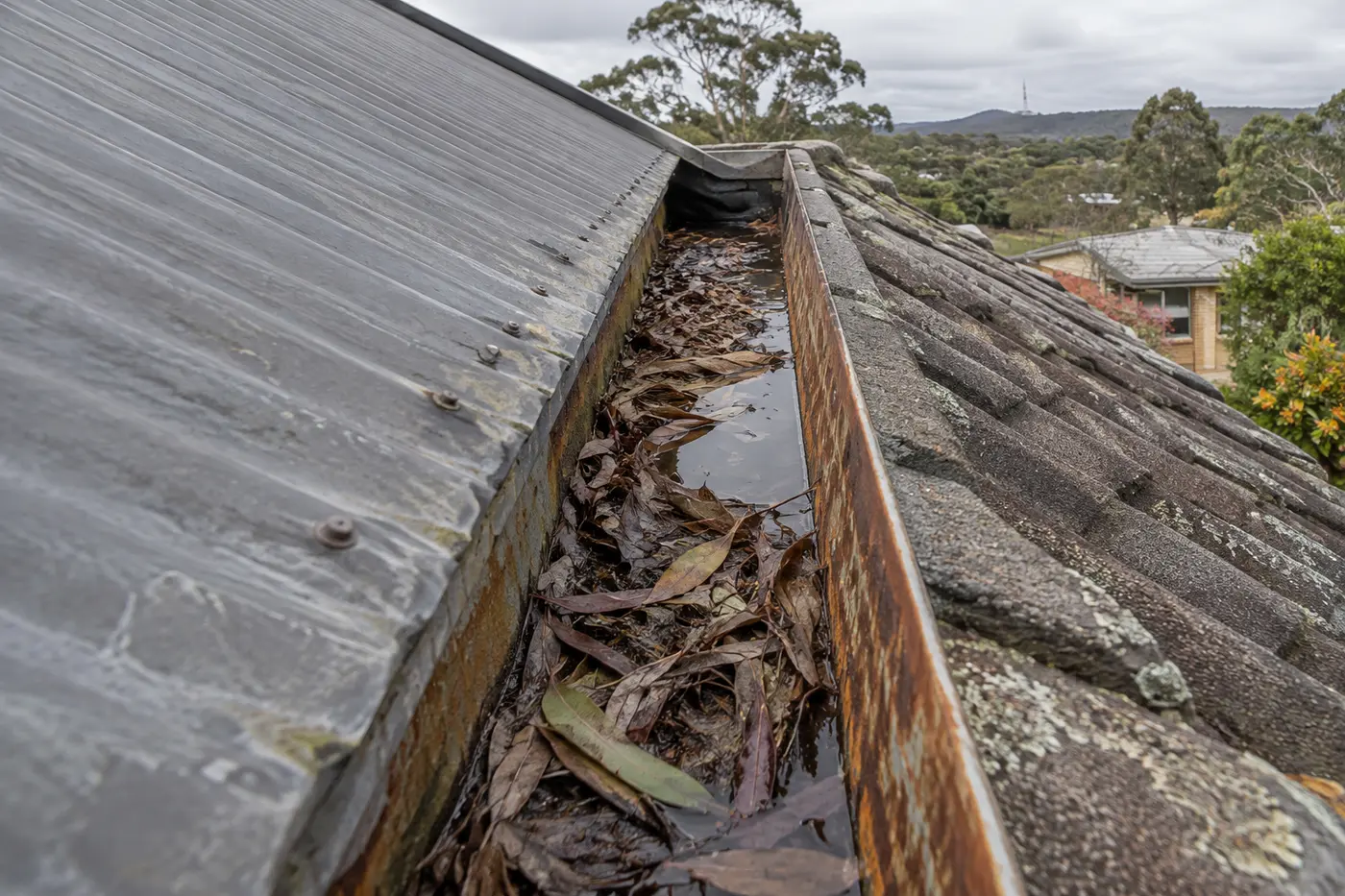
A box gutter is a metal channel built into the roof rather than hung off the edge. You'll find them between two roof sections, behind a parapet wall, or where an extension meets the original house. They're common on flatter modern rooflines and on renovations where a new roof was joined to the old one.
That position is the whole problem. An eaves gutter that overflows spills water down the outside of the wall. A box gutter that overflows has nowhere to go but in: into the roof space, onto the ceiling, sometimes down inside a wall. So a small fault in a box gutter usually does more damage than the same fault in an ordinary gutter.
When it leaks tells you a lot about why
Before anyone talks about repair or replacement, we want to know when the leak appears. That one detail narrows things down quickly.
- Only in heavy downpours. Usually the gutter can't move the volume. Think a blocked outlet, a sump choked with leaves, an outlet too small for the roof above it, or no overflow at all.
- In any decent rain. More likely a hole or a failed joint: rust pinholes, a split corner, old sealant that has cracked and let go.
- Only when the wind is up. Often the flashing at the end of the gutter or where it meets a wall, not the gutter itself.
If you can't tell which it is, that's normal. Water travels along timber before it drips, which is why our guide on how a roof leak is actually tracked down starts with the pattern, not the stain.
Most of the time, a repair is enough
Plenty of box gutters don't need replacing. If the steel is sound along its length and the trouble is in one place, a repair is the sensible answer, and we'll tell you that.
The most common fix we do is also the least dramatic: clearing a blocked outlet or sump. Leaves, seed pods and grit wash off the roof and settle at the lowest point, which is exactly where the water needs to leave. Under Canberra's big eucalypts this happens more than people expect. Clearing it, and sometimes fitting a guard over the outlet, can be the end of the leak. It's the same leaf litter problem we describe in what blocked gutters do to a Canberra roof, just in a spot where the overflow lands indoors.
A single failed joint or a lifted flashing at one end is also repairable, as long as the steel either side is in good shape. So is a small rust spot on an otherwise healthy gutter. And if there's no overflow, adding one is often part of the repair. Current roof plumbing rules expect a box gutter to have a way of shedding excess water outside the building. Many older ones were built without it.
Replacement makes sense once the problem is everywhere
Repairs stop paying off when the fault isn't in one place anymore. These are the signs we look for.
Rust along the length, not at one spot. Standing water is what rusts a box gutter. Once the base is pitted end to end, sealing one hole just moves the leak a little further along.
Layers of old patches. We often peel back a box gutter's whole history: silicone over bitumen over more silicone. Each layer traps water and dirt against the steel and hides what's going on underneath.
The fall is wrong. Fall is the slight slope that carries water to the outlet. If the gutter was built too flat, or the timber under it has sagged, water ponds in the low spots however well the joints are sealed. You can't seal your way out of a fall problem. The gutter has to come out and go back in at the right slope.
It was never big enough. If the gutter or its outlet is undersized for the roof area draining into it, it will overflow in every heavy storm, even when it's clean and watertight. Canberra's summer storms find that out fast.
The timber underneath is the part nobody can see
A box gutter sits on a timber base, often called the sole board, with timber sides around it. When a gutter has leaked slowly for years, that timber is usually the first thing to suffer, and you can't see it until the old gutter comes out.
Sometimes it's perfectly fine. Sometimes sections are soft and have to be replaced first, because a new gutter laid on rotten timber will sag and lose its fall again. This is the main reason two quotes for the same box gutter can look so different. A good quote says up front how rotten timber will be handled if it turns up.
Coatings buy time on a sound gutter, nothing more
You'll see liquid membranes and rubber coatings sold as a cure for leaking box gutters. On steel that is still structurally sound, with a proper fall, a well applied membrane can seal tired joints and small pinholes and stretch out the gutter's life.
What a coating can't do is fix a gutter that's the wrong shape, the wrong size or rusted through. It won't clear a blocked outlet either. If water still ponds after the coating goes on, it will find the next weak point. So we treat coating as one option for a gutter that's basically healthy, not a way around the real cause.
What we check before recommending either
On a leaking box gutter we look at the outlet and sump, the overflow (or the lack of one), every joint and corner, the condition of the steel along the base, the flashings at each end, and how the water sits after rain. We photograph what we find so you can see it without going up there yourself.
Then you get a straight recommendation: repair, coat or replace, and the reason for it. Box gutter work is part of licensed roof plumbing in Canberra, and we hold ACT Roof Plumber Licence 242220C. Getting the falls, laps and seals right is the job.
Each storm makes the job bigger
Box gutter leaks don't fix themselves. Every heavy downpour puts more water into the ceiling and the timber under the gutter. What might have been a cleared outlet or one resealed joint slowly becomes a replacement, plus new timber, plus ceiling repairs. If the same stain comes back after each big storm, that's the moment to get it looked at.
If you've got a ceiling stain after heavy rain, or you can see water sitting in a box gutter, we'll come out, find what's actually failing and give you a written quote. Book through our licensed roof plumbing service and we'll tell you honestly whether it's a repair or a replacement.