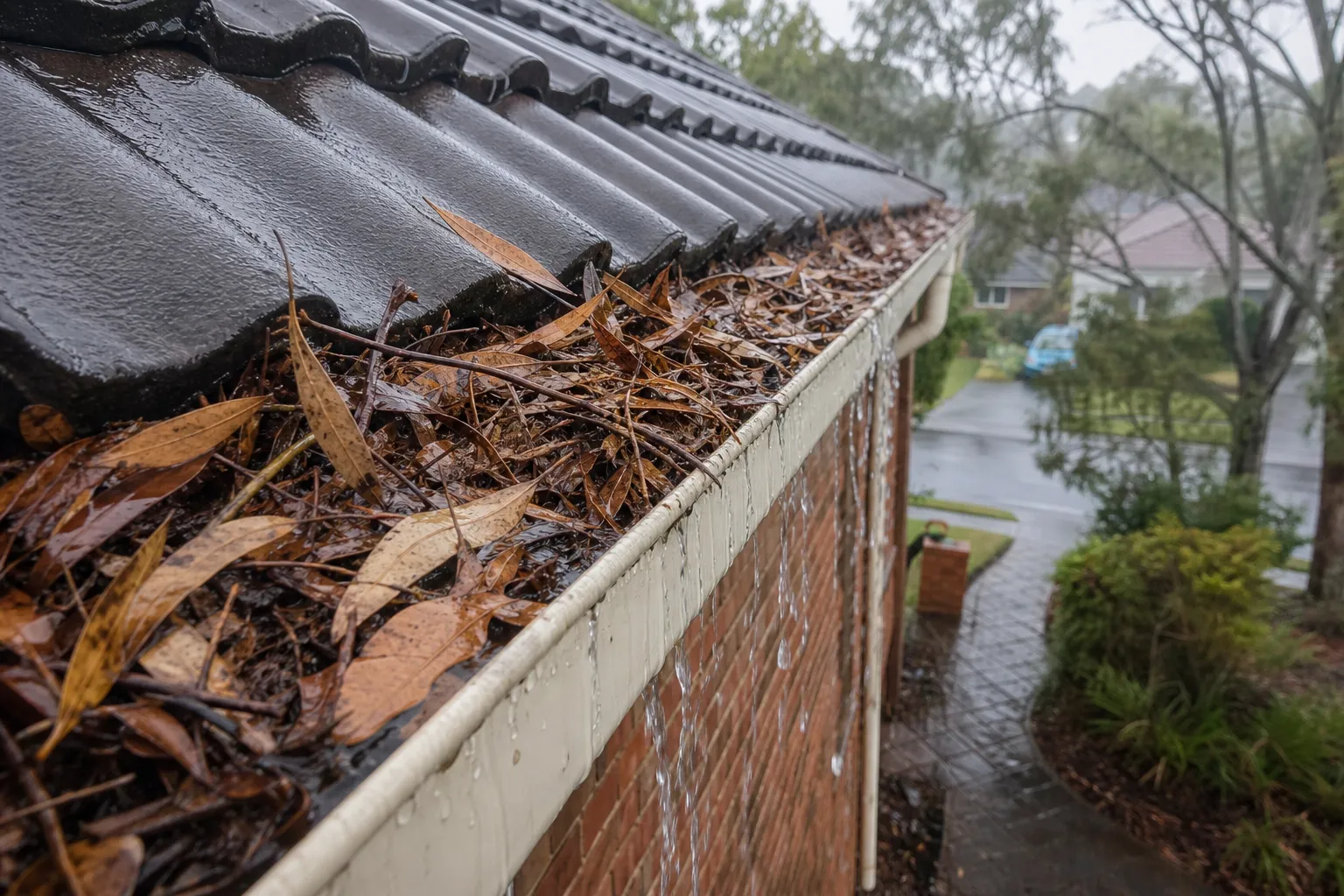
You only notice a gutter when it stops doing its job. Usually it's the first proper downpour after a dry spell: water sheeting over the front edge in a curtain, a waterfall off one corner, or a brown stain creeping down the render by the back door. By then the gutter has been quietly filling for months. We get called out to a lot of these across Canberra, and the frustrating part is that the gutter is rarely the real casualty. It's the roof, the fascia and the ceiling behind it that end up costing money.
This is a plain guide to what actually goes wrong when gutters block, why it happens faster here than in most cities, and how to stay ahead of it without turning it into a weekend on a ladder.
Why Canberra gutters fill up faster than most
Two things stack against us. First, the native trees. Eucalypts drop leaves, bark ribbons and gumnuts all year rather than in one tidy autumn dump, and that stringy bark is exactly the shape that knits into a mat and holds water. Second, the planned suburbs. Whole streets in Canberra were planted at once with the same deciduous exotics, so come April you get a concentrated leaf fall that can choke a gutter in a fortnight. Add the pine and cypress that edge a lot of older blocks, and you have fine needle debris that slips straight past a lot of coarse guards.
The result is that a Canberra gutter often needs looking at more than the once-a-year most people assume. Under heavy tree cover, twice a year is closer to the mark, and the timing matters as much as the frequency.
What overflowing gutters actually do to your roof
A blocked gutter does not just spill over the front lip and water your garden. Water backs up to the highest point it can reach, and on most homes that means it climbs back up under the bottom row of roofing before it finds the edge.
Rot in the fascia and roof timbers
The fascia is the timber board the gutter is screwed to. When a full gutter sits heavy and wet against it week after week, and water wicks in behind, that board stays damp and starts to rot. Once the fascia softens, the gutter brackets lose their grip and the whole line begins to sag, which makes it drain even worse. From there the damp can reach the ends of the rafters and the roof timbers, and that is a genuinely expensive repair rather than a quick fix.
Water tracking into the eaves and ceiling
When water banks up behind the gutter it gets under the first tiles or the edge of the metal sheeting, past where the roof is designed to shed it. On a tile roof it runs down the sarking if you're lucky and into the eaves if you're not. The classic sign is a brown ring blooming on the eave lining or the top corner of an inside wall after heavy rain, with no leak anywhere near it. People assume the roof has failed. Nine times out of ten the roof is fine and the gutter caused it.
Rust where you can't see it
Wet leaf litter sitting in a metal gutter holds moisture against the steel constantly, which is how gutters rust through from the inside first. The same happens along the roof edge and in the valleys, the metal gullies where two roof planes meet. A valley packed with debris is one of the most common leak points we find, because the water has nowhere to go but sideways under the tiles.
The winter version of the problem
On frosty Canberra mornings, water trapped in a debris-clogged gutter can freeze solid, especially on shaded south-facing runs that never see the sun. The ice blocks the flow completely, so the next melt or shower backs straight up under the roof. It's worth understanding how our cold snaps compound this, which we cover in our guide to frost and winter roof damage in Canberra. Going into winter with clear gutters is one of the cheapest bits of protection there is.
The bushfire angle
Canberra doesn't need reminding what embers can do. Dry leaf litter sitting in a gutter is a ready-made ignition point during a fire, which is why the RFS lists clearing gutters as a standard part of getting a home ready each season. If you back onto a reserve or bush edge, this one isn't optional.
How often should Canberra gutters be cleared?
There's no single answer, because it depends entirely on what's growing over your roof. As a rough guide:
- Open block, few trees nearby: once a year is usually enough, ideally in late autumn.
- Deciduous street trees or a leafy garden: twice a year, once after the main autumn drop and once in spring.
- Overhanging eucalypts, pines or a bush block: two to three times a year, and a check after any big wind.
The single most valuable clear-out is the one done in late autumn, before the first hard frosts and the winter rain arrive. Get that timing right and you head off most of the trouble above.
Does gutter guard actually help?
For homes under constant leaf fall, a good gutter guard is one of the better investments you can make, but it comes with an honest caveat. Guard slows the problem down, it does not end it. Quality aluminium mesh keeps leaves, birds and embers out and dramatically stretches the time between clean-outs. The cheap foam and plastic products often make things worse, because fine debris settles on top and roots grow into it, and then you're trying to clean a gutter with a lid on it. Matching the guard to your actual tree type, needle, leaf or bark, is the part worth getting advice on.
Signs your gutters need attention, from the ground
You don't need to climb up to know you have a problem. From the yard, look for water overflowing in rain rather than running to the downpipes, gutters visibly sagging or pulling away from the fascia, plants or grass sprouting out of the gutter line, dark tiger-stripe staining down the outside of the guttering, and paint blistering or timber staining on the fascia and eaves. Any of those means debris has been sitting long enough to cause harm.
When it's a roofing job, not just a clean
Clearing leaves is maintenance. But once water has been getting in for a while, you're often past a simple clean-out. Rusted-through gutter sections, a sagging line that no longer falls toward the downpipes, rotted fascia, or leaks coming from the valleys all need proper repair rather than another scoop-out. That's the point to bring in a licensed roofer. We handle the lot as part of our gutter, guard and downpipe repairs, from realigning and rehanging a tired run to replacing rusted guttering and fascia. Where the trouble is in the valleys or box gutters, that crosses into licensed roof plumbing work, which is the watertight detailing that stops those hidden leaks for good.
A word on doing it yourself. Ground-level downpipe checks are fine, but getting up to clear gutters, especially on a two-storey or a steep Canberra pitch, is how a lot of people end up in hospital each year. Wet leaves, a cold roof and a ladder on soft ground is a bad mix. If it's up high or you're not confident, it isn't worth the risk.
Frequently asked questions
Why do my gutters overflow the moment it rains?
Almost always a blockage. Debris has packed the gutter or, more commonly, the downpipe outlet, so water has nowhere to drain and spills over the front edge instead. Occasionally the gutter has sagged and no longer falls toward the downpipe. Either way it's telling you it needs clearing or realigning.
Can blocked gutters really cause a leak inside the house?
Yes, and it's one of the most common causes of an internal leak we see. Water banking up behind a full gutter gets under the roof edge and into the eaves or ceiling, showing up as a stain well away from the actual gutter. Fix the gutter and the leak usually stops.
Is gutter guard worth it in Canberra?
If you have eucalypts or deciduous trees over the roof, generally yes. A quality mesh guard cuts how often you need clearing and adds ember protection, which matters here. Just don't expect it to be maintenance-free, and steer clear of the cheap foam inserts.
Stay ahead of it
Blocked gutters are the small, boring problem that quietly funds big roof repairs. A clear gutter in autumn, a guard suited to your trees, and a proper repair the moment something has rusted or sagged will save you far more than it costs. If your gutters are overflowing, sagging or staining the walls, our local team can take a look, tell you honestly whether it's a clean or a repair, and sort out the guttering, fascia and downpipes properly. Book a free inspection and quote for gutter and downpipe repairs and keep the water where it belongs.