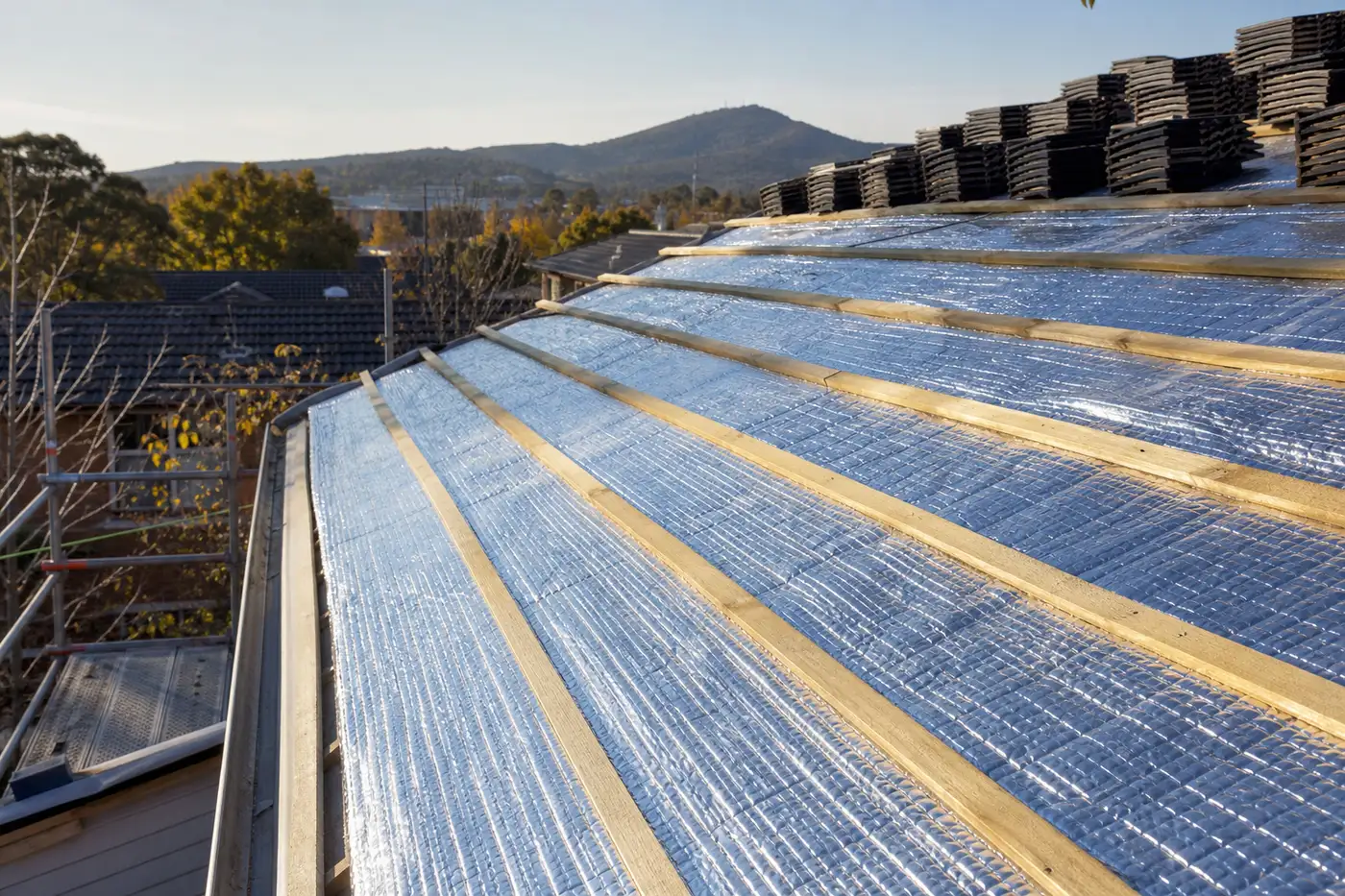
If you have ever had a quote for a new roof, you may have spotted a line on it for sarking and wondered exactly what you were paying for. Or maybe you have put your head into the roof cavity, seen a layer of shiny silver foil under the tiles, and had no idea what it was doing up there. So what is sarking, and does your Canberra home actually need it? In plain terms, it is a thin reflective sheet that sits under your roof tiles or metal sheets, above the timber frame, and quietly does a few important jobs.
We fit it on plenty of the re-roofs we do around the ACT, and we get asked about it constantly. Here is the honest rundown.
The silver layer most people never see
Sarking is a pliable, foil-faced sheet that comes on a roll. It gets laid across the rafters or battens before the tiles or metal go on, running in long strips parallel to the gutter and lapped so any water runs down and out. Once the roof covering is back on top, you never see it again from outside. From inside the roof space it looks like a smooth silver blanket following the slope of the roof.
You will hear it called a few other things. Sisalation is one, which started life as a brand name and stuck. Some people say reflective foil, or just roof blanket. On metal roofs a thicker foil-and-wool product called anticon does a similar job with a bit of built-in insulation. They are all variations on the same idea: a second skin underneath the main roof.
What that thin sheet actually does
For something so light, it earns its keep. A good sarking layer:
- acts as a second water barrier, catching wind-driven rain, dust and the odd minor leak and sending it down to the gutter instead of into your ceiling
- manages condensation, which is a bigger deal in Canberra than most people realise
- reflects radiant heat, so the roof space runs a little cooler in summer and holds warmth better in winter
- slows draughts, dust and embers getting into the roof cavity
Think of it as a bit of insurance built into the roof. On the day it matters, a tile cracks in a hailstorm or a screw backs out, the water hits the foil and runs away harmlessly rather than staining the plaster below.
Why it matters more through a Canberra winter
Here is the part that surprises people. A lot of the winter "leaks" we get called out to are not leaks at all. They are condensation.
Our nights get genuinely cold, and the underside of a roof drops well below the temperature of the air inside your home. Warm, moist air from cooking, showers and heaters rises into the roof space, meets that cold surface, and turns back into water. Without sarking, those drops fall straight onto the ceiling. With it, the moisture forms on the foil and is far better managed. If a damp patch has ever appeared after a cold snap with no rain in sight, condensation is usually behind it. We go deeper on that in our guide to frost and winter roof damage in Canberra.
Plenty of older Canberra roofs have none at all
Sarking only became common on newer Australian builds. A lot of the tile roofs we look at across the older suburbs went on decades ago, before it was standard, and have nothing under the tiles but batten and air. That is not a fault exactly, and a sound old roof can keep doing its job for years. But it does mean there is no backup layer, so a cracked tile, tired pointing or a lifted flashing has a clear run at your ceiling.
You can usually check your own. On a dry day, put your head into the roof cavity with a torch and look up. Silver foil following the rafters means you have sarking. Bare timber battens, with daylight showing between the tiles, means you do not.
The catch: it goes on when the roof comes off
This is the honest limitation. Sarking sits under the roof covering, so the only practical time to fit it is when the tiles or sheets are already off. That means during a full roof replacement, or when a section is being relaid. You cannot slide it in under an existing roof without lifting the covering first, and pulling an entire tile roof off just to add foil rarely stacks up on its own.
So the rule of thumb is simple. If you are getting a new roof anyway, adding a sarking layer is cheap next to the rest of the job and well worth it. If your existing roof is sound and only needs a clean, a restoration or a few repairs, we would not tell you to tear it off for sarking alone.
So is it worth adding?
For most Canberra homes going through a re-roof, yes. The winter condensation benefit alone makes a strong case here, and the extra water barrier and heat reflection are a bonus on top. It is one of those upgrades you fit once and then forget about, quietly doing its job for the life of the roof.
If you are weighing it up, the useful questions are whether the roof is due for replacement anyway, whether you have had condensation or damp-patch trouble, and how hot the roof space gets in summer. The answers usually make the decision for you.
Not sure whether your roof already has sarking, or whether it is worth folding into a job you are planning? We are a licensed Canberra roofing team (ACT Roof Plumber Licence 242220C), and we are happy to get up there, tell you honestly what is under your tiles, and talk through your options. Take a look at our roof sarking work or give us a call on (02) 6109 5008.