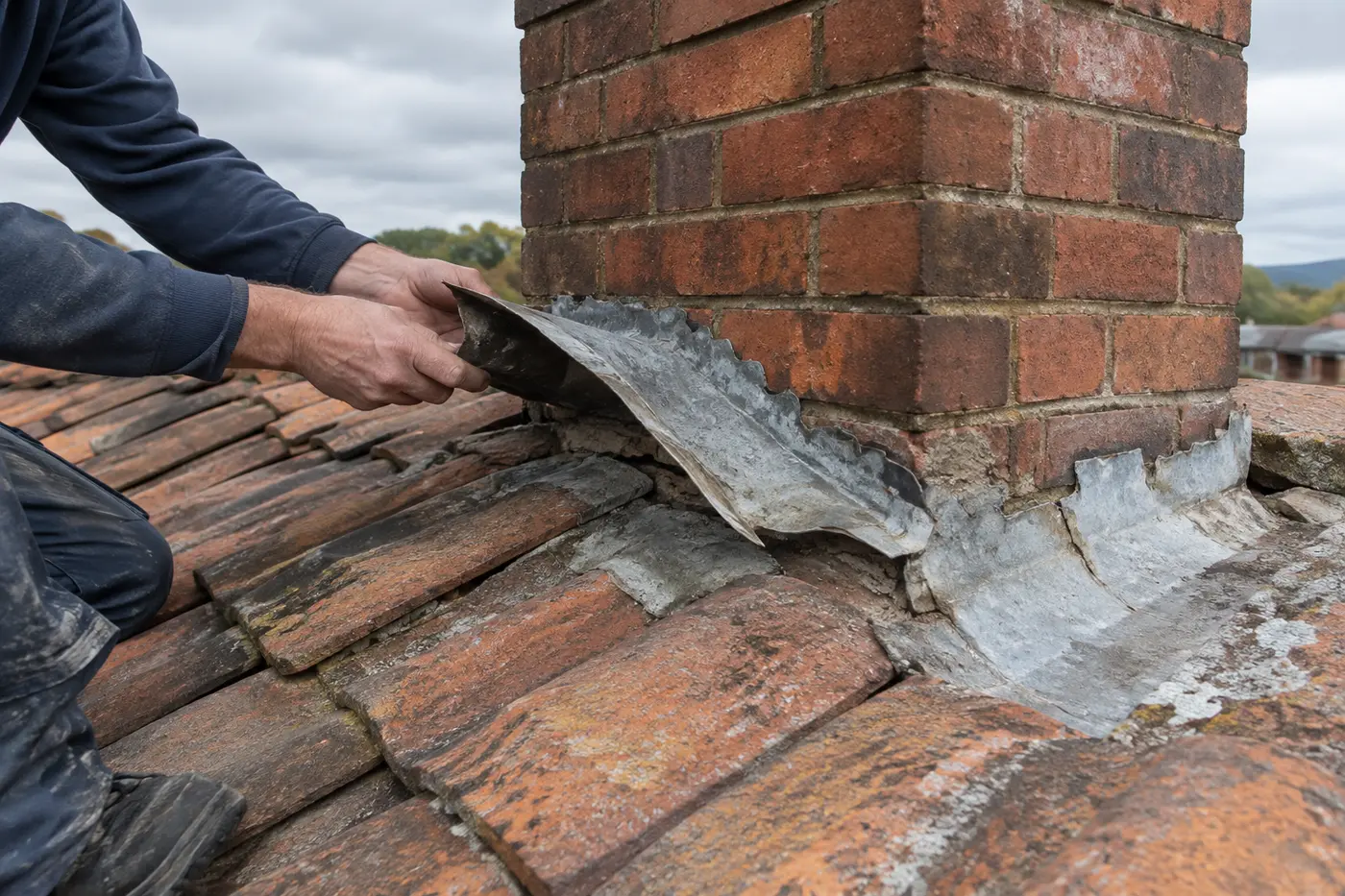
The leak only turns up in certain storms. A westerly drives the rain sideways, and a damp patch appears on the ceiling beside the chimney breast, or along the wall where the single storey part of the house meets the two storey part. The tiles look fine. Someone has been up and checked them. Yet it keeps happening.
When we get a call like that, our first suspect is the flashing. Roof flashing repair in Canberra makes up a big share of the leak work we do, because flashings sit at exactly the spots where water has the easiest way in. Here's what flashing is, why it fails on Canberra homes, and how to tell a proper repair from one that just buys a few months.
Flashing is the seal where the roof meets something else
A roof is good at shedding water across its open surface. The weak points are the joins: where the roof runs into a chimney, butts up against a wall, wraps around a skylight or has a flue or vent pipe poking through it. Flashing is the strip of metal (sometimes lead, copper or a flexible rubber material) that bridges each of those joins and steers water back onto the roof instead of into the gap.
There are a few kinds you'll hear a roofer mention:
- Apron flashing runs across the bottom of a chimney or wall, where water flows toward it head on.
- Step or side flashing runs down the sides of a chimney or wall, following the slope of the roof.
- Cover flashing (also called counter flashing) is tucked into a mortar joint in the brickwork and folds down over the flashing below it.
- Penetration flashings are the collars and rubber boots around flues, vent pipes, solar fixings and aerials.
A good flashing works mostly by overlap. Each piece sits over the one below it, the same way the tiles do, so water runs off the top instead of being forced through a seam. That detail matters later, when we get to sealant.
Why flashings fail on Canberra roofs
Most of the failed flashings we see come down to age, weather or a shortcut taken when the roof went on. Which one depends a lot on where in Canberra you live.
Older homes: lead that has cracked and lifted
The interwar and post-war homes through the Inner North and Inner South often still have their original lead flashings, and some of the grander Inner South homes have copper. Lead lasts a long time, but it eventually cracks and lifts. Our big swings between frosty mornings and hot summer afternoons make the metal move every day, and over decades that movement opens up splits and pulls the edges away from the brickwork. The mortar holding the cover flashing into the chimney crumbles with age too, so the whole flashing can work loose.
Tile roofs: mortar where a flashing should be
On some older tile roofs, the join at a wall or chimney was finished with a strip of mortar rather than a proper metal flashing. It looks tidy when new. Once frost gets into the hairline cracks, freezes and expands, the mortar breaks away from the wall and leaves a gap that water runs straight into.
Newer homes: builder defects
Homes in Gungahlin and the Molonglo Valley are a different story. The roofs are young, but we regularly find flashings that were never finished properly at the build: a penetration that was never booted, a wall flashing that stops short, or a lap running the wrong way. These leaks can show up in the first few years, which surprises people. If your home is still under a builder's warranty, a written report on the defect is worth having.
Any roof: the silicone patch that has given up
Sealant breaks down in sunlight. A flashing that has been held together with a bead of silicone for years will eventually crack, shrink and let go. If you can see thick, uneven sealant around your chimney or a flue, someone has probably patched a leak there before.
Signs your leak is coming from a flashing
You don't need to get on the roof to spot the clues, and please don't. Flashings sit at awkward heights and angles, and tiles crack underfoot. From the ground and from inside, look for:
- a stain on the ceiling or upper wall right next to a chimney breast, skylight or a wall where two roof levels meet
- a leak that only shows in wind driven or very heavy rain, not a light shower
- flashing that has visibly lifted, bent or pulled away from the brickwork, often after a windy storm
- rust streaks running down from a flashing on a metal roof
- a skylight shaft that gets damp at the edges
Water can travel a long way before it shows, so a stain near a chimney isn't proof on its own. If yours is hard to pin down, our guide on how a stubborn roof leak gets traced explains how a roofer narrows it down.
Sealant is a backup, not a repair
The most common "fix" we're called out to redo is a fresh tube of silicone run over a failed flashing. It feels like a repair, and it might hold for a season. The trouble is that a flashing is meant to keep water out through overlap and fixing, with sealant only as a backup. If the lead has split, the cover flashing has pulled out of the mortar, or the lap runs the wrong way, the sealant ends up as the only thing holding back the water. Once the sun breaks it down, you're back where you started, usually with a bigger mess to strip off first.
A lasting repair depends on what has actually failed. Sometimes it's as simple as refixing a cover flashing and repointing the mortar joint it sits in. Sometimes a section needs replacing. On an old chimney with cracked lead all round, re-flashing the whole chimney is usually the honest answer. Either way, the fix goes on the part that failed.
Flashing is licensed roof plumbing work
In the ACT, flashings fall under roof plumbing, which is a licensed trade. That's for good reason: get a lap or a fall wrong and the roof leaks no matter how good the tiles are. As licensed roof plumbers (ACT Roof Plumber Licence 242220C), we deal with flashings, valleys and the other watertight details every week, from re-flashing chimneys and wall joins to booting flues and solar fixings.
Materials matter too. Copper and coated steel don't mix: water running off copper onto Colorbond or Zincalume corrodes the steel. On a heritage home, keeping the original look means choosing the replacement material with care rather than smothering everything in modern sealant. On a metal roof, flashings need to sit cleanly with the sheet profile.
If you're planning a full restoration, the flashings should be checked and, where needed, replaced before any coating goes on. Painting over a failed flashing just hides it until the next storm.
What a flashing repair costs depends on what we find
We won't put a number on a flashing repair over the phone, because the cost depends on the cause. Refixing a loose cover flashing and replacing a full chimney flashing are very different jobs, and access to a two storey wall or a steep roof adds to either. Roof plumbing work is quoted by the job: a single flashing is a modest fixed price, and you get a written quote once we've found exactly what's leaking and why.
Get the flashing checked before the next storm
A flashing leak caught early is usually a small job. Left through a wet Canberra winter, it can soak the timber, sarking and ceiling below. Our roof inspections are free and come with a photo report, so you can see the cracked lead or the lifted flashing for yourself. Selected work is backed by a warranty of up to 15 years (conditions apply). To book, head to our roof plumbing service page or call (02) 6109 5008.